Measure the path from evidence to an implemented decision
Decision Velocity is a lens for examining the path from information to an implemented decision. It shifts attention from model speed or accuracy alone to the decision itself: who owns it, what evidence it needs, what constraints apply, and how an authorized action takes place.

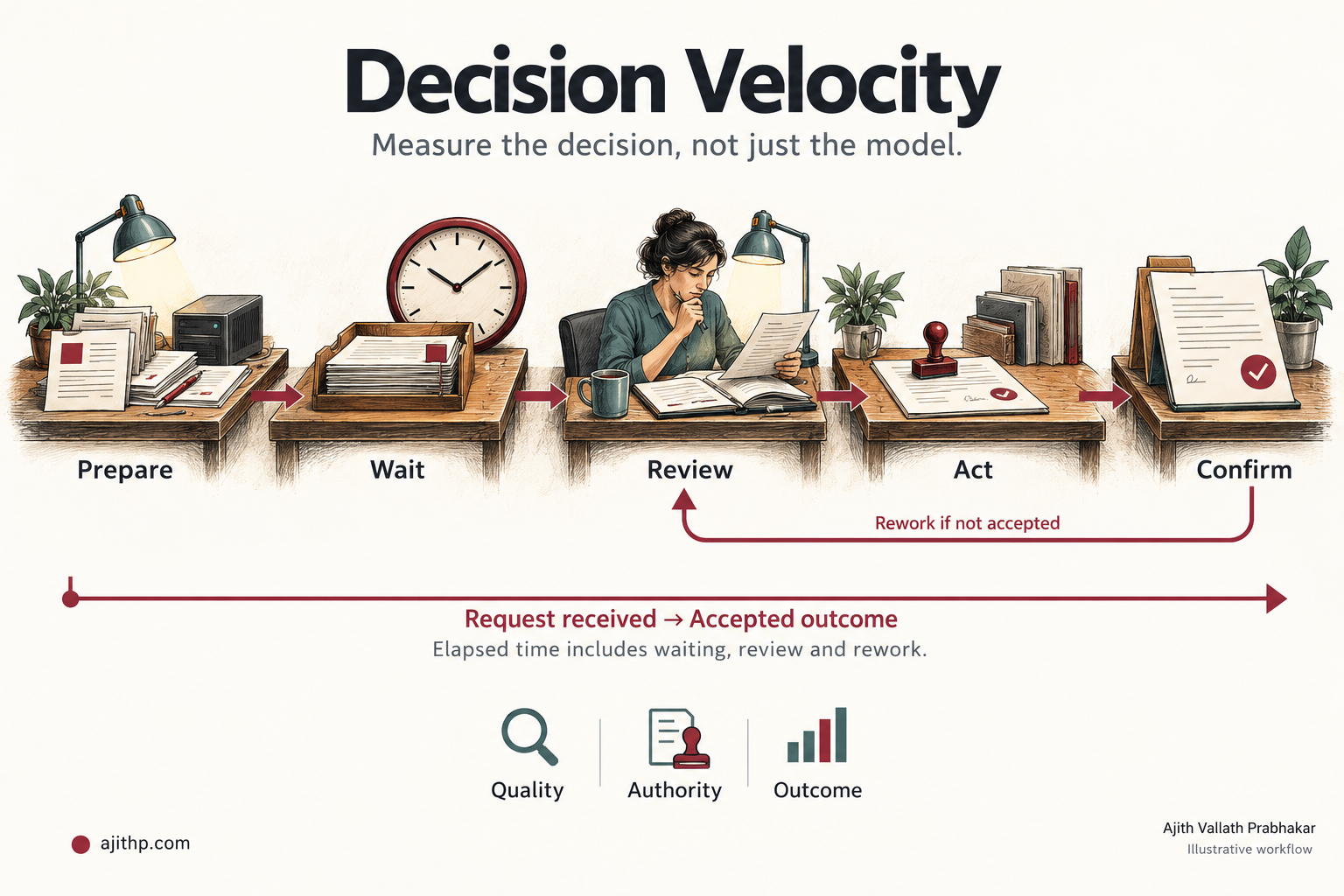
Use the illustrated worked example to examine one decision with your team, then record your own evidence and next test in the printable worksheet.
2 pages · Illustrated example and printable worksheet · No signup required
A practical way to examine one decision
- Define. Name one decision, its owner, purpose, acceptable risk, and the time constraints that matter.
- Design. Map the inputs, evidence, policy checks, model contribution, human review, and points where the process can stop or ask for help.
- Deploy carefully. Connect only the approved action to its operational endpoint. Preserve the decision context and record who or what authorized it.
- Defend and learn. Compare observed decisions with the stated objective. Review exceptions, overrides, delays, and outcomes, then revise assumptions where the evidence calls for it.
What to measure and test
For a chosen decision, define the start and end points before measuring elapsed time. Track the input and policy versions, decision path, human interventions, and action status alongside speed. Test routine cases, ambiguous evidence, missing context, changed policy, and situations where the system should defer. A shorter path is not better if it bypasses authority, evidence, or an important safeguard.
Connection to CTRS
Decision Velocity is one pillar of the Control Tower Reasoning System. Its analysis depends on organizational context: who can decide, which information is current, and what actions are possible. The Enterprise Digital Twin guide explores these context questions.
Measure the delay the customer actually experiences
Illustrative enterprise example: approving a duplicate-charge refund. A service agent sees two charges and asks an AI assistant to resolve the case. The assistant identifies the likely duplicate in seconds, but the refund waits in an approval queue, then waits again for a payments operator to submit it. Measuring the response time would miss both delays.
Start the clock when the team has the evidence it has agreed is necessary to assess the request: customer identity, the two transaction references, and the merchant’s settlement records. Record the earlier customer contact separately so time spent obtaining missing evidence remains visible. End the operational measure when the payment provider confirms that the refund was submitted successfully. Record customer receipt as a later outcome if it can be observed; submission and receipt are different events.
The process owner can now examine where the case waits. A reviewer may need to establish whether one charge has already been reversed. An operator may be working from an incomplete handoff. Faster model output will not resolve either condition. Changing the handoff or making the reversal status visible could be more useful than changing the model, but the timestamps should determine where to investigate first.
Keep a small case ledger
For each case, record the evidence-ready time, recommendation time, review start and end, approval owner, submission time, provider response, and any reopening. Add the reason for each hold. Compare similar cases and report the distribution of elapsed times alongside incorrect refunds, duplicate submissions, and cases returned for missing evidence. Do not average straightforward cases together with disputes that require a different decision process.
Success means reducing avoidable waiting while preserving the agreed approval boundary and refund correctness. A case with incomplete settlement evidence should remain unresolved with a named next step. Failure includes submitting the same refund twice, reporting success after a provider rejection, or making the time measure look better by starting the clock only after the difficult work is finished. A faster process has earned its improvement only when the recorded outcome supports it.
Further reading
Bring a decision flow, constraint, or counterexample to a working conversation.
You must be logged in to post a comment.