From an AI answer to an accountable decision
The Control Tower Reasoning System (CTRS) is an architectural framework for connecting enterprise context, decision processes, and agent action. Its central question is practical: what must an AI system know, and what controls must surround it, for its output to support a decision an organization can examine and own?
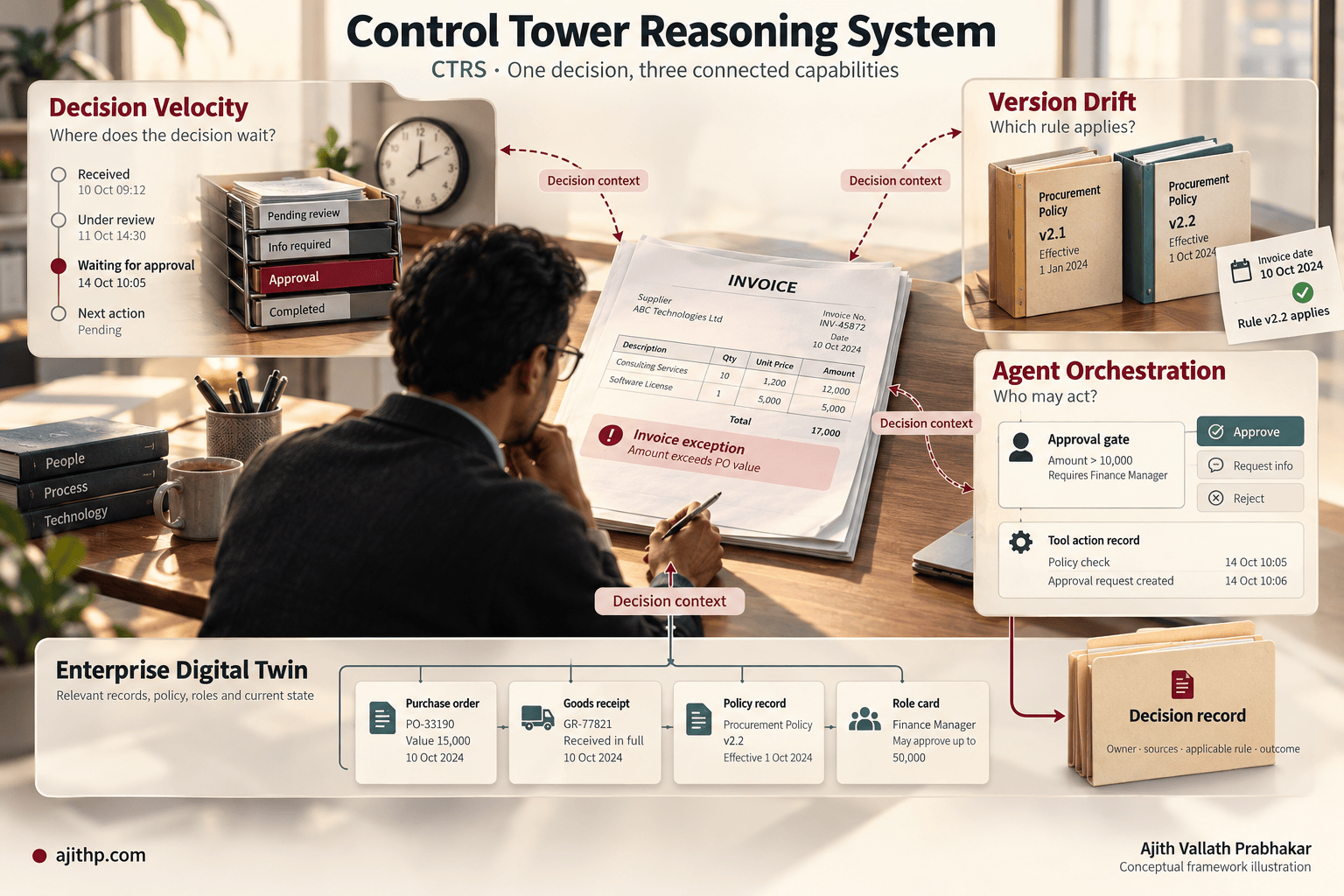
Use the illustrated worked example to examine one decision with your team, then record your own evidence and next test in the printable worksheet.
2 pages · Illustrated example and printable worksheet · No signup required
Situational awareness is an architectural requirement
A model does not establish which policy applies, who has authority, whether information is current, or whether an action is permitted. Those questions belong to the system around the model. The Enterprise Digital Twin is the proposed context foundation in this framing: a representation of relevant authority, policy, operational state, institutional memory, and constraints.
How to use the model
- Name one decision. Identify its accountable owner, purpose, and the action that may follow.
- Map the context. List the policies, facts, authority, current state, and constraints the decision depends on, including their sources and effective dates.
- Set the control boundary. Specify what the model may recommend, what a person or policy must authorize, and which system executes the action.
- Test the path. Try representative, conflicting, expired, missing, and disallowed inputs. Check whether evidence, decisions, and interventions can be traced.
Three connected pillars
Decision Velocity asks how intelligence becomes an actionable decision. Version Drift Prevention asks whether the knowledge used remains authoritative and applicable. Agent Orchestration asks how agent actions fit within organizational controls. Each is a separate lens on the context and decision system.
Work through a decision with competing facts
Illustrative enterprise example: releasing a supplier payment. An accounts-payable assistant recommends paying an invoice because the goods have been received and the invoice matches the purchase order. Before payment, a message asks the team to use a new bank account. The match is still correct. The recommendation is now incomplete because the intended destination of the money has changed.
CTRS starts with the decision the organization must own: whether this payment may be released to this account. The Enterprise Digital Twin supplies the relevant organizational context, including the approved supplier record, payment controls, current account-verification status, and the person authorized to release funds. It need not represent the whole enterprise to be useful for this decision; it must represent these dependencies accurately enough to expose what is missing.
The three pillars then have distinct jobs. Decision Velocity follows the payment from a complete request to an executed or withheld action, including time waiting for verification. Version Drift checks that the payment rule and delegation in force apply to this transaction. Agent Orchestration connects the recommendation to the payment system while keeping the release decision within the agreed authority boundary. A message requesting an account change is evidence to investigate, not authority to rewrite the supplier record.
Produce a decision record
Keep a compact record containing the invoice and supplier identifiers; amount and destination; source records and their timestamps; applicable control version; named decision owner; unresolved checks; approval or refusal; and the payment-system reference or explicit hold status. Someone reviewing the case should be able to reconstruct why that destination was accepted.
The exercise succeeds when a verified destination can proceed through the approved release path, while an unverified change produces a visible hold with an owner. It fails if a correct invoice match is treated as sufficient authority, an expired delegation is accepted, or the assistant reports payment without confirmation from the payment system. Test those cases separately: they reveal different weaknesses even when the final answer sounds equally confident.
You must be logged in to post a comment.