Quick brief
AI, sensors, and biology can form useful feedback systems when each handoff is explicit and testable. The value depends on the task, the evidence behind each action, and the controls around data, models, and living systems.
Full analysis
Revised October 19, 2026.
A biological measurement can arrive every second while the result that matters arrives hours later. A model may recommend a change before anyone has checked whether the measurement is trustworthy. Connecting AI to sensors and biology therefore raises a practical question: which part of the system is allowed to learn, which part can act, and what evidence is required before it does either?
In its 2025 Tech Trends Report, Amy Webb and Future Today Strategy Group (FTSG) used living intelligence for a convergence of artificial intelligence, advanced sensors, and biotechnology. FTSG’s description of strategic foresight frames such work around plausible futures that can inform present decisions, so the phrase is useful as a lens on connected systems rather than the name of one established architecture, maturity level, or deployment schedule.
Sensors provide observations about a physical or biological process; software can organize those observations, compare them with a goal, and propose a next step. Biological engineering can change the process being studied, while biological tissue can itself be part of a computing experiment. Those pieces complement one another when the measurement, decision, action, and result can be traced.
Four terms describe four different operations
FTSG describes living intelligence as systems that “sense, learn, adapt, and evolve.” That compact description is a useful starting point, but the four operations remain distinct. A system may do one without doing the others.
Sensing means measuring a signal. A probe estimates dissolved oxygen in a fermentation vessel; a continuous glucose monitor estimates glucose from interstitial fluid. Every measurement has a sampling interval, calibration history, and conditions in which it becomes unreliable. “Real time” means that a result arrives soon enough to inform a particular decision; sensors still reveal only what they are designed to measure.
Learning changes a model or another part of a system’s behavior using evidence. A team might retrain a model after reviewing measurements from completed experiments. A deployed model may receive readings all day while its parameters stay fixed, so continuous measurement alone does not demonstrate continuous learning.
Adaptation changes an action in response to a measurement or model estimate. A conventional controller can switch a pump on when a threshold is crossed without changing its own rules; a model might estimate an adjustment while a separate controller enforces an allowed range. Neither operation requires the model to rewrite itself.
Evolution has a specific biological meaning: heritable change across generations in a population. Software discussions often use the term for any improvement over time, but retraining a model, changing a controller setting, and selecting a different microbial strain are separate events with different records and review needs.
The distinctions help teams describe what is changing. A soil-moisture sensor that switches irrigation on demonstrates useful feedback control. An automated process that learns from new examples, changes its control policy, or selects among biological variants needs separate evidence for those capabilities.
The useful unit is a testable feedback loop
A connected system can be described as a sequence: measure a state, check the measurement, compare it with an objective, choose an action, observe the result, and decide whether the next version of the system should change. These steps can run at different speeds. A sensor may report frequently, a laboratory assay may take hours, and model updates may happen only after several completed batches.
That timing shapes the design. If the assay that measures product concentration arrives once per batch, the system cannot claim to optimize that concentration at every second. It can use faster measurements as proxies, but the team must test whether those signals predict the slower outcome well enough for the intended decision.
Separate the runtime controller from model development. The controller can apply established bounds while an offline model proposes candidates for a later review. If the model is eventually allowed to influence operations, its version, input quality, recommendation, accepted action, and observed outcome should remain linked. A reviewer should be able to reconstruct what happened without guessing which model or sensor configuration was active.
Ordinary feedback control already connects measurements to physical actions. The distinctive contribution may come from a better measurement, an experiment that narrows uncertainty, a model that selects a useful next test, or a biological component that performs a task the existing process cannot. The comparison is with the current system on the same objective, not with an abstract idea of “traditional AI.”
Biological computing has shown a narrow feedback experiment
In the 2022 DishBrain study, Brett Kagan and colleagues tested human stem-cell-derived cortical cultures and primary mouse cortical cultures as separate experimental groups on a multielectrode-array platform connected to a simplified Pong environment. The paper lists Kagan and coauthor Andy Kitchen with Cortical Labs affiliations, alongside coauthors at academic and research institutions. Electrical stimulation represented aspects of the game; recorded activity influenced the paddle. The researchers reported changes in gameplay performance under structured feedback that they interpreted as learning.
That result supports a specific claim: living neural tissue participated in a closed-loop experiment on a defined task. It does not establish a general-purpose computer, a commercial replacement for a silicon processor, or lower total energy use after culture support and laboratory equipment are counted.
The interpretation was debated. In a 2023 exchange in Neuron, Fuat Balci and colleagues challenged the intelligence and sentience language and aspects of the evidence and controls. The paper’s title uses “sentience”; in their reply, Kagan and colleagues said they intended the term in a “deflationary and principled” way under the free-energy principle. The exchange leaves interpretation contested, and the task result does not demonstrate consciousness in the ordinary sense.
DishBrain also differs from organoid intelligence. The DishBrain experiment used a two-dimensional neuronal culture. Lena Smirnova and colleagues’ 2023 paper proposes a research program based on three-dimensional brain-cell cultures, new interfaces, and ways to train and assess such systems. The paper describes a field to build, including substantial technical and ethical work. A later Brainoware study used an organoid-based reservoir-computing system for speech recognition and nonlinear-equation prediction. These defined tasks show a specific computing approach; they do not establish general-purpose computation.
Cortical Labs now advertises the CL1 device and Cortical Cloud, including remote experiments through a Python SDK. These official product pages were checked October 19, 2026. Their existence gives research teams something concrete to evaluate, but a product page is not an independent benchmark. A buyer still needs evidence on access, task performance, experimental repeatability, culture lifetime, support equipment, and total operating cost.
Molecular prediction and protein design serve different steps
The AlphaFold 3 paper, published in 2024, describes prediction of structures for complexes involving proteins and other molecules, including nucleic acids and small molecules. The authors also document limitations, including stereochemical errors, hallucinations, accuracy on some targets, and difficulty representing molecular dynamics. A predicted structure helps researchers decide what to investigate; it does not replace measurement of how a molecule behaves under relevant conditions.
AlphaProteo addresses a different problem. It generates candidate proteins designed to bind selected targets. In its September 2024 research account, Google DeepMind reported experimentally successful binders for seven targets and failure on an eighth, TNFα. The technical report says TNFα was selected after the seven-target experiments as a particularly difficult eighth target based on in-silico analysis. The result is evidence about the tested targets and methods, not a guarantee that a new target will work.
The original technical report names SC2RBD, PD-L1, and TrkA among targets used during method development, and the authors note that success on those targets may overstate performance on new ones. The report distinguishes them from additional prospective tests. A team comparing the approach with other methods should inspect that distinction and test its own target.
The research workflow still has several handoffs: generate candidates, apply computational filters, make candidates, test them, and determine what the assay says. The technical report says it omits the machine-learning methods for biosecurity and commercial considerations; DeepMind’s 2024 announcement also described phased sharing of the system. A pilot plan therefore needs to state which model access and steps the team can actually reproduce. Strong binding in a laboratory assay remains several steps away from an effective therapy.
The connection to living intelligence is the loop between model and experiment: a model proposes what to make, laboratory measurements show whether the candidate behaves as expected, and those results may guide the next design round. That loop is useful when it reduces uncertainty for a defined research decision, not because the molecule itself senses or learns.
Industrial biology depends on experiments and handoffs
Ginkgo Bioworks provides an example of how a company describes connecting biological engineering, data, and automation. In an August 2023 partnership announcement, Ginkgo and Google Cloud described the Foundry’s software, automation, and experimental data as resources for developing AI tools for biology and biosecurity. A contemporaneous SEC filing records the five-year partnership as an intention to develop and deploy those tools.
The engineering pattern is design, build, test, and learn. A team sets a biological objective, creates candidates, measures their behavior, and uses the results to decide what to test next. Automation can connect parts of that cycle, but the measurement and handoff still determine what the model has learned. The announcement does not establish that organisms in production redesign themselves or that every customer obtains an economic benefit.
For an enterprise review, ask for the record behind a claimed improvement. It should connect the biological candidate and its lineage to the assay, the operating conditions, the result, and the next design decision. Compare candidates under the same conditions before attributing a change to the design. A different assay, operator, or process setting can produce a different result without the biological candidate being better.
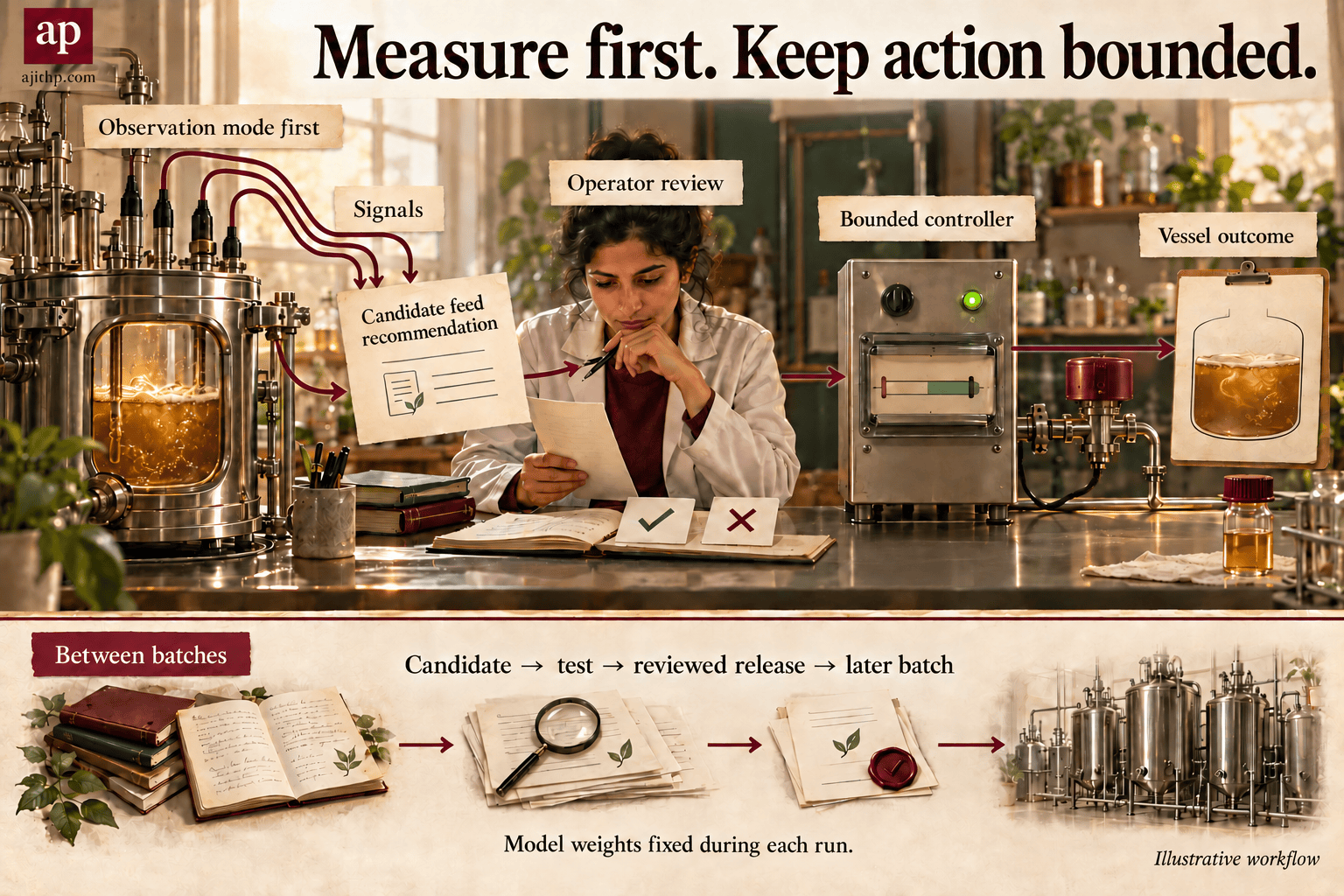
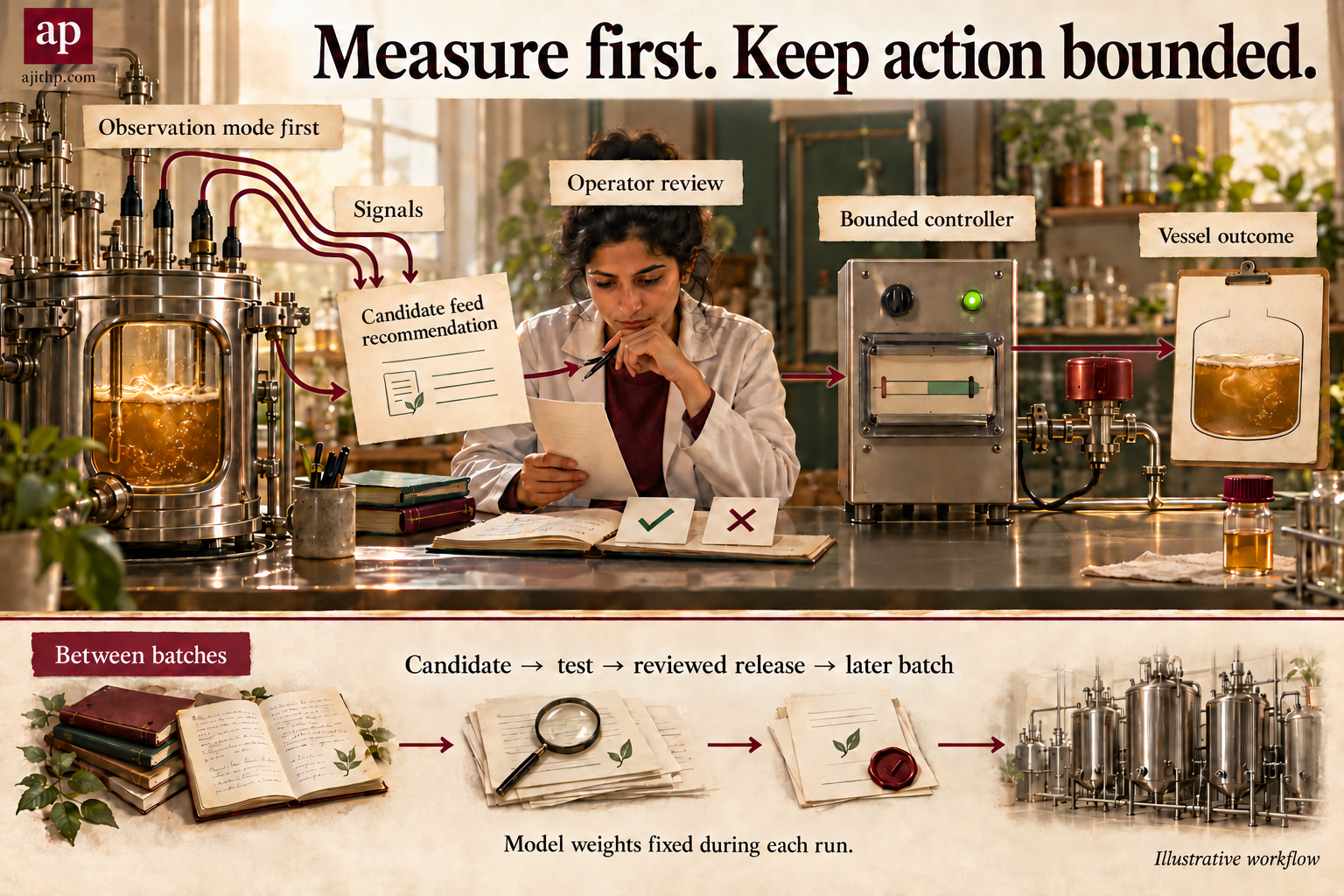
Consider a contained fermentation process at an enzyme manufacturer. This hypothetical evaluation scenario is not a customer deployment or measured result. The existing process controls temperature and agitation, and the team wants to know whether a model could improve a nutrient-feed decision.
Probes report pH, temperature, and dissolved oxygen. Samples sent to an assay provide product concentration later. Before allowing a model to affect a feed pump, the team can run it in observation mode and record recommendations beside the existing controller’s actions. Each record would include model version, sensor timestamps and calibration status, strain identity, the proposed adjustment, and the action actually taken. A disagreement may point to a useful experiment, but observing an unexecuted recommendation cannot establish what it would have done to yield.
If the team later permits limited control, the allowed range and the conditions that return control to the established system should be explicit. The operator needs to see the reason for a proposed change while there is still time to intervene. Missing sensor readings, an assay that disagrees with the model, or a result outside the expected range should lead to a defined pause or fallback, not silent continuation.
The first version can keep model updates outside the operating loop. Researchers can assess a candidate against completed batches before deciding whether it should influence another one. That delays adaptation, but it preserves a reproducible system while evidence accumulates. Relevant measures could include product yield under comparable conditions, batch variability, exception-investigation time, and the cost of added assays and instrumentation. If a more reliable assay and better batch records solve the problem at lower cost, those may be the better investment.
Five sectors, five different evidence questions
Healthcare, education, customer service, manufacturing and materials, and environmental management present different evidence questions. The same convergence label does not make their evidence interchangeable. In each case, start with the decision and identify what has actually been demonstrated.
| Sector | Evidence class | Useful question and boundary |
|---|---|---|
| Healthcare | A specific cleared device | In May 2023, FDA cleared the iLet pump and dosing software for people aged six and older with type 1 diabetes when used with a compatible integrated continuous glucose monitor. The FDA describes body-weight initialization and meal announcements as user inputs, and calls the device an adaptive closed-loop algorithm that learns over time to respond to individual insulin needs. This is evidence about that device and indication. It does not support a generic claim that monitoring systems can adjust cardiac medication or reduce hospital admissions. |
| Education | Hypothesis to evaluate | A learning tool could change the next exercise after an incorrect answer or a request for help. The team would need to test whether that response supports the intended learning objective. An answer pattern does not establish a learner’s emotional state, and no improvement or equity result should be assumed. |
| Customer service | Hypothesis to evaluate | A system could offer a clearer explanation or human escalation when a customer repeats a question or asks for help. That option can be tested without inferring emotion from voice or biometric signals. Satisfaction and loyalty claims require their own outcome evidence. |
| Manufacturing and materials | Illustrative evaluation scenario | The contained fermentation example tests a feed recommendation against an existing process. It can measure yield, variability, exceptions, and added cost. The example does not demonstrate a self-optimizing factory or self-healing material. |
| Environmental management | Research and risk-assessment question | Sensors may identify a change in water or soil conditions. Whether an engineered organism should be used beyond a contained setting is a separate risk and authorization decision; a sensor alert or promising model prediction is not evidence of ecosystem benefit. A U.S. EPA Science Inventory record for a 2024 research presentation describes planned research on evidence gaps about native-microbiome effects in open-release applications. |
The table separates a cleared device from a proposed classroom feature, a service design hypothesis, an illustrative industrial evaluation, and environmental risk assessment. A team can use it to decide where it has evidence and where it only has a question.
Governance belongs at the points where the system can change
Governance becomes practical when it assigns decisions. For every connected system, specify who may view data, propose an action, approve it, execute it, change the model, and review the outcome. Those permissions need not belong to the same role. A record should preserve the input and its quality, the recommendation, the action taken, and any intervention.
Privacy and consent. A signal collected to operate a device may later look useful for analytics or model training. State the original purpose, whether secondary use is allowed, who can access the data, how long it is retained, and how a person can change a permission where applicable. Continuous collection should not silently become permission for every later use.
Bias and measurement quality. Fairness cannot be added by allowing a model to adapt. Check whether sensors and assays have different error patterns across the people, conditions, or equipment the system will encounter. Keep those errors visible in the record and evaluate whether the decision changes when the input is less reliable. A model cannot correct a signal problem that the system does not detect.
Biological ethics. The organoid-intelligence paper calls for “embedded ethics,” with ethical questions considered alongside technical work and with relevant stakeholders involved. Questions about tissue provenance, research consent, and the possible moral status of increasingly complex cultures deserve careful review. The DishBrain task result does not establish consciousness, and software-access rules cannot resolve those broader questions.
Biosafety and dual use. A contained experiment, a manufacturing process, and an environmental release raise different questions. The NIH Guidelines describe biosafety practices, containment, and institutional review for research involving recombinant or synthetic nucleic acids within their scope. NIH’s draft Biosafety Policy, released on August 19, 2026, is intended to replace the Guidelines when finalized; the draft and the currently published Guidelines should be distinguished. That is not a universal rule for every biological project or jurisdiction. For potential environmental release, an EPA Science Inventory record for a 2024 research presentation describes planned research on evidence gaps for genetically engineered microbes. Risk decisions still require the applicable assessment and authorization, alongside any model prediction.
Operational safety. A system needs a defined response when a sensor is stale, an assay conflicts with a model, the model version is unknown, or an action falls outside its permitted range. Decide when it should return to the established controller, pause for an operator, or refuse the action, then test those conditions before giving the system more authority. Safety evidence should include tests of the paths that stop operation when readings, model versions, or actions fall outside bounds.
Each control answers a different question. Privacy, biological containment, model validity, and authority to act each need evidence of their own. Review the actual path from data to action.
Invest in the decision the loop can improve
The convergence thesis invites investigation, while each application has its own evidence and pace. A neuron-based experiment, protein-design model, industrial fermentation process, and medical device have different objectives and maturity. Grouping them under one phrase does not align their economics or establish a shared trajectory.
Start with a decision that is expensive, slow, or unreliable. Identify the measurement that could change it, the action that follows, and the experiment that would show whether the change helped. Then compare a better sensor, a more reliable assay, an updated model, a conventional controller, and a biological component on the same task.
In the enzyme example, the next investment might be a better assay and more complete batch records. Those could make a later model-assisted controller worthwhile. If the existing controller already meets the need at lower cost, keeping it is sound engineering. A new system earns its place when its measured contribution justifies the added complexity and its data, authority, and failure paths remain understandable.
Related reading
- Neuromorphic Computing: How Brain-Inspired Technology is Transforming AI and Industries
- Exploring Agentive AI: Understanding its Applications, Benefits, Challenges, and Future Potential
- Unlocking Explainable AI: Key Importance, Top Techniques, and Real-World Applications
- AI Deception: Risks, Real-world Examples, and Proactive Solutions
- Benchmarking Large Language Models: A Comprehensive Evaluation Guide
Sources
- Future Today Strategy Group, 2025 Tech Trends Report, executive summary, and strategic foresight FAQ.
- Kagan et al., “In vitro neurons learn and exhibit sentience when embodied in a simulated game-world,” Neuron (2022).
- Balci et al. and Kagan et al., 2023 critique and reply on DishBrain terminology and claims; the combined critique-and-reply PDF is also available.
- Smirnova et al., “Organoid intelligence (OI): the new frontier in biocomputing and intelligence-in-a-dish,” Frontiers in Science (2023).
- Abramson et al., “Accurate structure prediction of biomolecular interactions with AlphaFold 3,” Nature (2024).
- Google DeepMind, AlphaProteo research announcement (September 2024) and technical report, version 1.
- Cai et al., “Brain organoid reservoir computing for artificial intelligence,” Nature Electronics (2023).
- Ginkgo Bioworks and Google Cloud, partnership announcement (August 29, 2023); Ginkgo SEC filing.
- U.S. FDA, iLet pump and dosing-software clearance announcement (May 19, 2023).
- U.S. NIH Office of Science Policy, biosafety and biosecurity policy / NIH Guidelines and August 2026 announcement of the draft replacement Biosafety Policy.
- U.S. EPA Science Inventory, 2024 ORISE research-presentation record on engineered microbes and open release.
- Cortical Labs, CL1 and Cortical Cloud official product pages, checked October 19, 2026. Product-page descriptions are company claims; no device, cloud account, or benchmark was independently tested.
Discover more from Ajith Vallath Prabhakar
Subscribe to get the latest posts sent to your email.