
Quick brief
AI time savings can make additional review capacity worth funding. In the example, preparation rises from 100 to 200 agreements a week while qualified review capacity stays at 120. The initial planning gain is 20 reviews, not 100 completed contracts.
Funding another 40 comparable reviews raises the planning limit to 160 if the work justifies the full cost. Decide which work receives the capacity, which expense actually changes, and how the decision reaches the people relying on it.
Suppose a contract team uses AI to prepare twice as many agreements for legal review. Sales has customer work waiting and wants to send more of it through. Finance sees an opportunity to bring work back from outside counsel. The general counsel wants lawyers to spend more time on difficult agreements. Each expectation makes sense on its own, but they are asking the same improvement to do different things.
This company and the figures below are hypothetical. The team can keep its current review staff and handle some additional work, or the company can invest in more review capacity if the additional business justifies it. Before the trial, additional reviewers would have been waiting for documents. Faster preparation changes what the next investment could achieve.
Finance and the business sponsors need to settle that choice before a saving goes into the budget or Sales offers an earlier date. Otherwise, each team can commit the company to a different use of the gain, leaving Legal to work out which promise it cannot keep.
Decision velocity, one pillar of the CTRS framework, follows information through to an implemented decision. Here, that means changing the work Legal accepts, the help Finance funds, and the dates Sales gives its customers.
If faster preparation makes additional review capacity worth buying, a larger legal budget can be the right next step after a successful AI trial.
Listen or watch the overview
Listen to the 3-minute audio overview or watch the 2-minute illustrated version. Both use AI-generated narration and original music.
Faster preparation can make more review time worth buying
For a simple illustration, take one class of similar agreements. Contract-operations staff prepare the documents, and lawyers review them. Preparation has limited the team to getting 100 agreements ready each week. The lawyers’ planning estimate is that they can review 120 of this class, and there is enough waiting work to use that additional capacity. AI raises preparation capacity to 200 without, for now, changing the review work.
On those assumptions, the initial gain is capacity for 20 additional reviews a week. Preparation capacity rises by 100, while the existing lawyers have room for only 20 more. Figure 1 follows that change through a second investment in review capacity. Negotiation and signature remain separate where required.

See the capacity figures
Weekly capacity for comparable agreements. The limit assumes enough eligible work.
| Scenario | Preparation | Review | Planning limit |
|---|---|---|---|
| Before the trial | 100 | 120 | 100 |
| After faster preparation | 200 | 120 | 120 |
| If review capacity rises by 40 | 200 | 160 | 160 |
Separating the roles matters. Time saved by the people preparing documents does not automatically give a specialist more time to negotiate an unfamiliar provision. If the lawyers also do the preparation, or if AI helps them review, the estimate needs to change. The 20-review illustration exposes a choice under stated assumptions; an actual department would need its own estimate.
The estimate also needs to account for variation in the work. Taking on 20 additional straightforward agreements is a different promise from accepting 20 agreements of any kind. Once the business hears a larger number, people will start planning around it, so the scope belongs in the promise from the beginning.
The business therefore has two decisions:
Which work should receive the initial gain?
Is the work beyond the first 120 reviews worth the cost of additional help?
Without changing preparation, buying more review capacity would previously have left that capacity waiting for documents. Now preparation can supply up to 200, so additional review time has a use it did not have before.
If the company buys capacity for another 40 reviews of this class, its planning limit becomes 160 reviews a week. That remains within preparation capacity, but the business case has to include hiring, supervision, quality control, and coordination alongside the AI tool.
The company does not need to buy enough review capacity for all 200 agreements simply because the tool can prepare them. Some of the waiting agreements may justify the expense; others may not. A temporary pile of old requests may justify a short engagement, while a continuing stream of valuable work could support a longer investment.
Sales and Finance need to agree on what comes first
Sales wants the lawyers to handle customer agreements that are currently waiting. Finance wants to move suitable work from outside counsel to the internal team and reduce an external bill. Both uses draw on the additional review capacity, so time given to one leaves less for the other.
The comparison is between the value of bringing customer work forward and the external expense the company could avoid. The full value of a sales opportunity is a poor substitute for that analysis.
If the customer is not ready to proceed, clearing Legal a week earlier may change little. If legal review is the remaining obstacle to an otherwise ready agreement, the time may have a much more direct use. Sales should therefore identify what an earlier review would change, not only the value of the customer relationship.
Finance needs the same discipline. Bringing an agreement inside will not reduce a fixed external fee simply because an internal lawyer has taken it on. The saving depends on which expense changes. The company should be able to explain the cost it will avoid before using that saving elsewhere in the budget.
The general counsel’s request for more attention on difficult matters is a third use of the time, with a different purpose. The company can choose it, but it cannot also describe all of that time as additional deal capacity.
If the existing workload depends on lawyers regularly catching up after hours, reducing that dependence needs to be part of the choice. Otherwise, the business case relies on extra effort from the team without acknowledging what it is asking them to contribute.
The leaders need to choose the benefit they are buying within Legal’s obligations, the expertise required, and the consequences of delay. The team should not have to settle that choice through the order in which people chase their requests.
The product launch still needs specialist help
Now suppose Procurement needs a specialist for a supplier agreement supporting a product launch. The people who could handle it are already responsible for a renewal deadline.
The 20 additional reviews concern a familiar class of agreements. They do not supply the expertise required for this supplier agreement. CLOC’s service-delivery guidance connects the type of work, its risk and cost with the resources suited to handling it.
Finance cannot use faster preparation in one class of work to justify a blanket reduction in specialist spending elsewhere.
The product leader and Legal still need to explain what buying help would change. If the agreement is the remaining obstacle to an otherwise ready launch, earlier review may have a direct business use. If other work will hold up the launch anyway, faster legal review may leave the launch date unchanged.
The specialist shortage existed before the trial, so funding it needs its own justification. The renewal obligation also remains in the plan. Any external savings need to be assessed after including the cost of the help the company actually chooses to buy.
Some routine contracts could stay out of the review queue
Before adding more lawyers, the company can examine which agreements need their attention and which could be handled more simply. Bupa’s legal leaders described selecting frequent, low-risk contracts for document and workflow automation in a September 2022 account published by Josef, its provider. That choice preceded its GenAI policy and playbook tools described in October 2024.
The contract team could examine routine NDAs for a similar route. Legal would need to define which terms and circumstances fit the route and when a request must come back for review. Exceptions, support, and maintenance would still take time. Ten NDAs handled through self-service would not necessarily make room for 10 difficult supplier agreements. The remaining work could take longer and require different expertise.
Any staffing plan therefore needs to reflect both the time released and the work those lawyers can now take on. Reducing dependence on after-hours work can be worthwhile in itself; before allocating the released time to more agreements, the team needs to establish which work it can support.
The team should also test the form of AI assistance separately. In the October 2024 discussion paper Building a Better Lawyer, Aileen Nielsen and colleagues tested 206 law students reading legal complaints. AI-generated highlighting reduced task time by about 30%, with no detected deterioration in the measured quality indicators. Summaries alone did not improve performance.
That gives the team a reason to test assistance inside the review, including checking and correction, rather than assume that another summary will help. The study’s percentage is not a capacity forecast for these lawyers or their contracts.
Testing a better routine route or review assistance can be sensible while the company provides qualified help for an urgent agreement. The launch should not have to wait for an unrelated experiment to prove a future benefit, and that benefit should not already be promised to Sales. The company can fund the immediate need while testing whether a different way of working will reduce the continuing need for additional help.
Sales and Procurement need dates that Legal can support
After this discussion, the company should have one plan that Sales, Finance, and Legal can all recognize.
For the familiar agreements, that means choosing the work for the first 20 additional reviews and deciding whether to buy capacity for the next 40. A proposal to buy specialist help should identify:
- the agreement it will serve;
- the business consequence it addresses;
- when the help needs to start; and
- what the arrangement will cost.
Any spending reduction claimed in the budget should reflect the allocation the company actually chooses.
The decision also has to reach the teams planning around it. If the leaders defer Procurement’s supplier agreement, Procurement may still be arranging a supplier start around the earlier review date. The team needs the revised date so it can change that plan and stop relying on timing Legal can no longer support.
The agreement remains unfinished work, with a reason for waiting and a point at which it will be reconsidered. Calling it deferred does not make its consequence disappear from the investment decision.
If the leaders buy capacity for the next 40 reviews, Finance’s approval has to lead to people being available for that class of work. Legal’s plan should show which additional agreements they will handle, and Sales should know what Legal has agreed to take on and when.
The same applies to specialist help for the launch. The product team needs to know when the person will start and what the arrangement supports. Figure 2 follows the funding and deferral decisions into the work and plans they change. Completing an agreement remains a further outcome, with review and any necessary negotiation still to do.
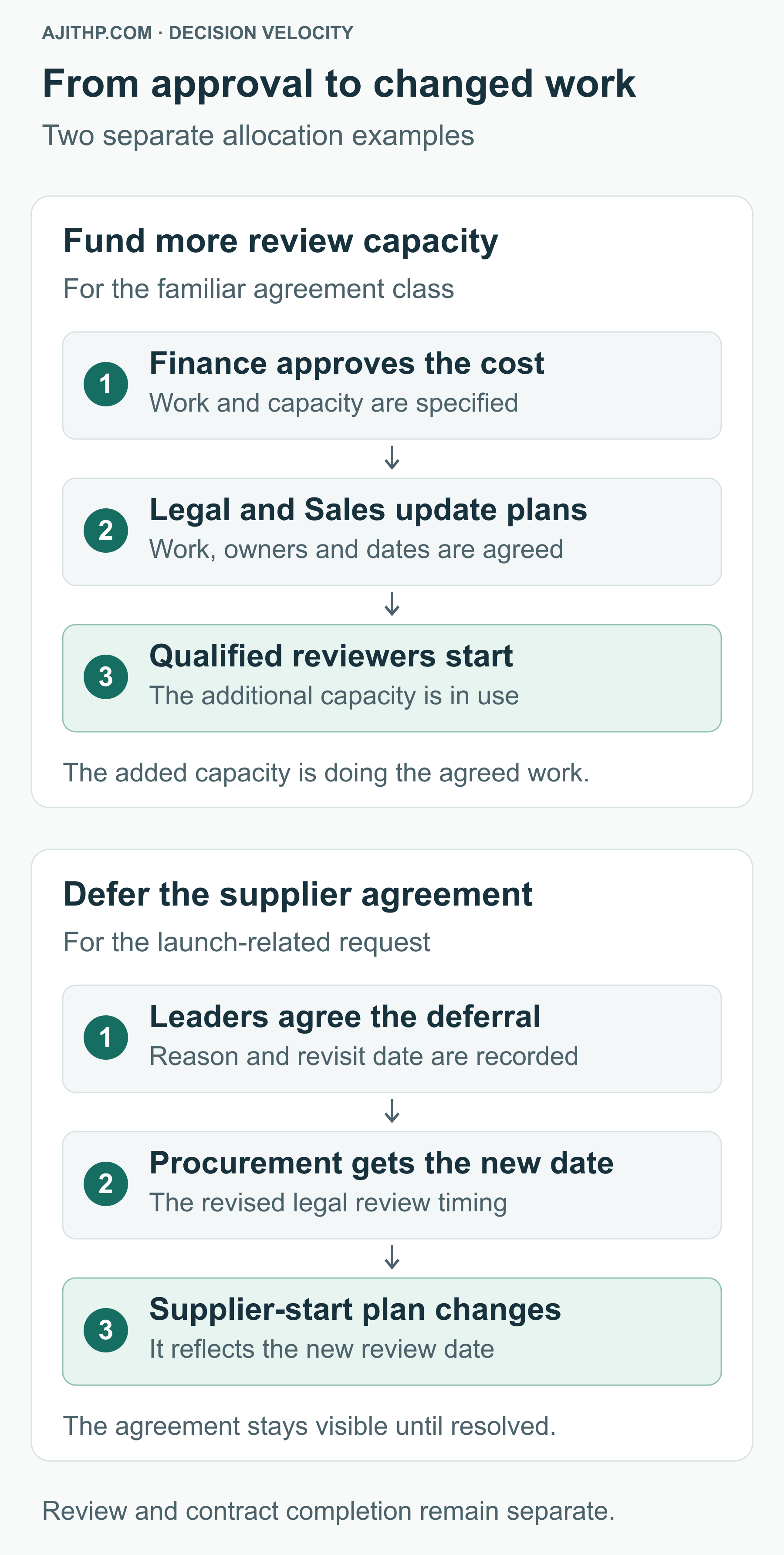
Read the decision steps
Fund more review capacity
- Finance approves the cost. Work and capacity are specified.
- Legal and Sales update plans. Work, owners and dates are agreed.
- Qualified reviewers start. The additional capacity is in use.
The added capacity is doing the agreed work.
Defer the supplier agreement
- Leaders agree the deferral. Reason and revisit date are recorded.
- Procurement gets the new date. The revised legal review timing.
- Supplier-start plan changes. It reflects the new review date.
The agreement stays visible until resolved.
The company can follow these steps using the approach in Enterprise AI has a measurement problem, without treating a faster recorded decision as proof that the business has benefited.
The accepted work must retain the review conditions discussed in Making human oversight work for AI agents, including the time and authority to act on what the reviewer finds.
Conclusion: agree which work to fund
A plan for the first 20 additional reviews can proceed alongside a separate case for the next 40. That case needs to explain which work would move forward, what bringing it forward would change, and what the additional help would cost. If the work justifies that expense, a larger legal budget can be the right result of a successful AI trial. Finance and the business sponsors need to agree on that investment before Sales offers dates to customers.
The next planning meeting should end with a named allocation of work, the capacity that supports it and the cost the company has agreed to bear. Legal needs to know which agreements to accept. Sales and Procurement need dates they can plan around. Finance needs to know which expense will actually change. If those decisions are still open, the team has demonstrated a useful improvement in preparation, but the company has not yet settled how to use it.
Key takeaways
- Measure the gain through the next stage of work. In this example, preparation rising from 100 to 200 supports 20 additional reviews with existing review capacity of 120.
- Allocate the released time explicitly. More customer work, less outside-counsel spending and more attention to difficult matters compete for the same capacity.
- Assess additional review capacity on the work it would enable and its full operating cost. Faster preparation can make that investment worthwhile.
- Match the help to the agreement. Capacity for familiar contracts does not supply missing specialist expertise.
- Count a cash saving only when an expense changes, and follow funding or deferral decisions through to the people, assignments and dates they affect.
Frequently asked questions
Why does doubling preparation produce only 20 additional reviews?
The example starts with preparation capacity of 100 agreements a week and qualified review capacity of 120 for one comparable agreement class. Raising preparation to 200 leaves review capacity unchanged, so the planning limit rises from 100 to 120. This assumes enough suitable work is waiting. It is an illustration of the constraint, not a forecast of an actual legal department’s throughput.
Does this mean a successful AI project should increase the budget?
It can, but the extra spending needs its own business case. Faster preparation may allow added reviewers to do useful work instead of waiting for documents. Whether to fund them depends on the agreements they would handle, the consequence of bringing those agreements forward and the full cost of the additional capacity. A temporary backlog and a continuing stream of valuable work may justify different arrangements.
When does time saved become a financial saving?
When the chosen change reduces an expense the company would otherwise incur. Moving an agreement to an internal lawyer does not reduce a fixed external fee by itself. Released time may instead support more work, better attention to difficult matters or less dependence on after-hours effort. Those can be worthwhile benefits, but they should be described and measured as the benefits actually chosen.
Why not buy another drafting tool before hiring more lawyers?
First establish which part of the work needs help. In this example, preparation already runs ahead of review. Another drafting tool needs to show how it helps with the remaining constraint. Review assistance or a well-defined self-service route may be useful alternatives, provided the evaluation includes checking, corrections, exceptions and maintenance. A specialist supplier agreement can still require expertise that neither option provides.
Can the research result be used to increase the capacity estimate by 30%?
No. The Nielsen study tested law students reading legal complaints, using particular forms of AI assistance. It supports testing the form of help within review; it does not establish how much faster this team can review contracts. The team needs its own evidence on comparable work, including review quality and the time needed to check and correct suggestions.
What should happen to agreements that are deferred?
Keep them visible as unfinished work, with a reason for waiting, a point for reconsideration and an owner who understands the consequence. Send revised review timing to the people planning around the agreement. In the supplier example, Procurement’s supplier-start plan must reflect the decision; moving the agreement out of an active queue does not remove its business consequence.
References
- CLOC — Service Delivery Models. Guidance on matching legal work and risk to appropriate internal and external resources.
- Josef — Bupa legal team embarks on contract automation journey with Josef, 8 September 2022. Provider-published account of selecting frequent, low-risk contracts for automation.
- Josef — “It’s so easy!” How Bupa made legal and compliance help on-demand with AI, 22 October 2024. Provider-published account of Bupa’s later GenAI policy and playbook tools.
- Aileen Nielsen, Stavroula Skylaki, Milda Norkute and Alexander Stremitzer, Building a Better Lawyer: Experimental Evidence that AI Can Increase Legal Work Efficiency, Harvard John M. Olin Discussion Paper No. 1111, October 2024. Experiment involving 206 law students; highlighting reduced task time by about 30%, while summaries alone did not improve performance.
Related articles
- Enterprise AI has a measurement problem — follow the path from faster work to an implemented decision and its outcome.
- AI token economics: what does a successful task actually cost? — compare operating costs through accepted work rather than model-call prices alone.
- Making human oversight work for AI agents — preserve the evidence, time and authority a reviewer needs to act on what they find.
- Buying an AI agent: three questions before you commit examines the service scope, evidence and full operating cost before commitment.
Research note: Bupa’s accounts are provider-published descriptions of its approach, not an independent capacity evaluation. In the Nielsen study, ETH funded experimental implementation and participants; Thomson Reuters contributed tool access and expertise, and two authors were affiliated with the company. The study’s result is not a forecast for the contract team.
Discover more from Ajith Vallath Prabhakar
Subscribe to get the latest posts sent to your email.