

Audio Overview
Video Overview
The $847 Million Architecture Decision Most Boards Can’t Answer
Recently, I spoke with a Fortune 500 CXO who had just committed $847 million to an “enterprise AI transformation.” When I asked, “Are you building Compound AI systems or Multi-Agent Systems?” he paused. “Aren’t those the same thing?”
They’re not. And the difference will determine whether his investment delivers 3× ROI or becomes a write-off.
This isn’t an isolated case. Across 47 enterprise AI deployments I’ve analyzed over the past 18 months, the pattern is consistent: leadership teams conflate architectural paradigms, procurement teams evaluate demos instead of topologies, and engineering teams build impressive prototypes that never scale.
The missing piece here is the strategic architecture literacy at the executive level.
Executive Summary
Enterprise AI has reached an inflection point: monolithic LLM calls no longer suffice for mission-critical workflows. Organizations must now fund modular, multi-agent architectures that decompose complex objectives, coordinate specialized agents, and integrate runtime governance. Leaders who allocate Q1 budgets to observability platforms, interoperability standards (MCP, A2A), and cross-functional transformation squads will definitely separate from competitors still piloting isolated use cases.
The transition from single-model applications to coordinated teams of agents is a fundamental architectural shift rather than merely an incremental change. While industry surveys indicate that many organizations are experimenting with AI, and evidence suggests that most large enterprises now implement generative AI to some degree, qualitative reports reveal a significant execution gap. Many organizations struggle to move beyond proof-of-concept systems to achieve production-ready, autonomous operations. This gap is primarily caused by inadequate governance frameworks, a lack of effective observability tools, and the inherent complexity of coordinating multiple intelligent agents with overlapping responsibilities.
Two parallel ecosystems are competing for enterprise adoption. On one side, there are open-source orchestration frameworks such as LangGraph for stateful workflows, AutoGen for conversational collaboration, and CrewAI for role-based teams. While these frameworks offer customization, they come with the drawback of lower operational maturity.
On the other side, integrated commercial platforms from companies like NVIDIA, OpenAI, and Microsoft provide enterprise-grade security, tracing, and support, but at the expense of architectural flexibility.
At the same time, emerging interoperability protocols are transforming the infrastructure layer. The Model Context Protocol (MCP), introduced by Anthropic in November 2024, standardizes communication between models and tools. Additionally, Agent2Agent (A2A), which is now overseen by the Linux Foundation, facilitates collaboration among task-oriented agents.
Together, these protocols create a communication stack comparable to HTTP and TCP/IP. They decouple agents from proprietary orchestration logic, helping to prevent vendor lock-in.
Autonomy introduces new risks that traditional IT governance is ill-equipped to handle. Issues such as coordination failures among agents, emergent behaviors at runtime, and advanced prompt-injection attacks create vulnerabilities not present in conventional software systems. The focus has shifted from enhancing model capabilities to developing AI Trust, Risk, and Security Management (TRiSM) frameworks. These frameworks are designed to enforce runtime guardrails, log every interaction between agents for auditing purposes, and allow human intervention when predefined safety boundaries are violated.
Performance Metrics for Multi-Agent Systems
Evaluating multi-agent system effectiveness requires new, process-level KPIs beyond task accuracy:
- Task Success Rate (TSR): The proportion of user objectives successfully completed without human intervention.
- Formula: TSR = (Successfully Completed Tasks) / (Total Tasks Attempted)
- Data Source: Task execution logs from orchestration framework (e.g., LangGraph state transitions, CrewAI task completions)
- Benchmark: Production systems should target ≥85% TSR for well-defined workflows
- Information Diversity Score (IDS): Measures the semantic uniqueness of inter-agent messages to detect redundant communication, which inflates token costs and latency.
- Formula: IDS = 1 – (Cosine Similarity Between Agent Message Embeddings)
- Data Source: Vector embeddings of agent-to-agent messages stored in message queue or communication layer (e.g., A2A protocol logs)
- Benchmark: IDS >0.7 indicates effective coordination; <0.5 signals redundant agent dialogue
- Unnecessary Path Ratio (UPR): Quantifies wasted reasoning effort when agents explore redundant solution paths.
- Formula: UPR = (Total Reasoning Steps – Minimal Steps to Solution) / (Total Reasoning Steps)
- Data Source: Execution trace graphs from observability platforms (e.g., LangSmith, NVIDIA NeMo Toolkit traces)
- Benchmark: UPR <0.3 indicates efficient collaboration; >0.5 requires architectural optimization
Economic Realities and Strategic Imperatives
The ongoing operational costs of multi-agent systems pose challenges for traditional IT economics. Internal benchmarks from Anthropic indicate that multi-agent workflows can consume up to 15X more tokens than single-call interactions. This increase is primarily due to planning overhead, intermediate reasoning steps, and communication between agents. Moreover, the “communication tax,” which refers to token duplication during the reasoning and verification phases, can reach 86% in poorly optimized systems. Therefore, it is crucial to prioritize cost efficiency during the architecture design stage rather than addressing it after deployment.
Success at scale requires four foundational investments:
- Data and API Infrastructure: Secure, abstracted API gateways that enforce authentication, rate limiting, and audit logging for agent access to ERP, CRM, and data lakes
- Observability and Tracing Platforms: Production-grade tools (e.g., LangSmith, NVIDIA NeMo Toolkit) that log every agent decision, tool invocation, and inter-agent message for debugging and compliance
- Interoperability Standards Adoption: Early implementation of MCP and A2A protocols to future-proof architecture and prevent vendor lock-in
- Organizational Restructuring: Transition from isolated AI centers of excellence to durable, cross-functional “transformation squads” embedding business analysts, data engineers, AI specialists, and IT architects
The unit of transformation must shift from optimizing individual tasks to redesigning end-to-end business processes for agentic execution.
The New Taxonomy of Intelligent Systems
As enterprises transition toward more complex AI architectures, the market is flooded with a host of new, often overlapping terms. Establishing a clear and structured taxonomy is the first step toward developing a coherent strategy. We will first deconstruct the key concepts by clarifying the distinctions between agentic AI, compound systems, and multi-agent systems, then outline a maturity model for enterprise adoption.
Defining the Landscape: From Agentic AI to Compound Systems
At the heart of this transformation is the concept of the AI Agent, which can be formally defined as a computational entity that perceives its environment through sensors, reasons about its perceptions, and takes actions to achieve specific goals. This definition moves beyond the idea of a passive model that responds to prompts and introduces the capability for goal-directed action.
Building on this, we can view Agentic AI not as a particular type of system but as a trait or capability a system can have. It indicates the level of autonomy, adaptability, and goal-oriented reasoning that an AI demonstrates. An agentic system can set sub-goals, select tools, and execute complex plans with little human oversight to fulfill a user’s goal. This is an important distinction: a system can be considered “agentic” without being a full multi-agent system.
For example, a single Large Language Model (LLM) utilizing a ReAct (Reason+Act) loop to browse the web and respond to queries exemplifies agentic behavior.
An alternative, more practical, and commonly used form is the Workflow Agent. These agents are designed to perform specific, often multi-step, business processes by interacting with various tools, systems, and APIs.
For example, a workflow agent could automate customer onboarding by collecting data from a CRM, performing a compliance check through an external API, and updating an ERP system. They serve as a pragmatic entry point for enterprise automation, focusing on goals while functioning within clearly defined, structured workflows.
Distinctions between Multi-Agent Systems (MAS) and Compound AI
While we often use “Compound AI” and “Multi-Agent Systems” interchangeably, they describe distinct architectural philosophies with different levels of complexity and ideal use cases.
A Compound AI System consists of multiple interconnected components, such as different AI models, retrievers, code interpreters, or external tools, all integrated into a single architecture to accomplish a specific task. The key feature of a compound system is its emphasis on module integration. These components often operate within a centralized or hierarchical control framework, where a central orchestrator manages data flow and execution. Because of their relatively simpler design, compound systems are ideal for the Proof-of-Concept (PoC) or Minimum Viable Product (MVP) phases of an AI project.
An example of this is a Retrieval-Augmented Generation (RAG) pipeline, which combines a vector database (retriever), an LLM (generator), and a reranker (filtering component).
A Multi-Agent System (MAS), in contrast, is a system that utilizes multiple autonomous, intelligent agents to perform complex, high-level tasks through collaboration, coordination, and communication. Here, the emphasis shifts from the integration of passive modules to the dynamic interaction of independent, goal-driven agents. These agents may have specialized roles, possess their own internal state and memory, and can be organized in various topologies, including centralized, decentralized, or hybrid structures. MAS are designed to tackle problems that are too complex for a single agent to solve, enabling a “divide and conquer” approach. Because of their greater coordination and communication complexity, they are better suited for scaling solutions beyond the MVP stage.
An example is a simulated software development team where a “CEO” agent defines requirements, a “Developer” agent writes code, and a “Tester” agent validates the output.
| Dimension | Compound AI System | Multi-Agent System (MAS) |
|---|---|---|
| Core Architecture | Integrated pipeline of passive components (retrievers, models, tools) coordinated by central logic | Network of autonomous agents with independent reasoning, memory, and decision-making capabilities |
| Coordination Model | Centralized orchestrator controls data flow and execution sequence | Decentralized or hierarchical; agents communicate via protocols (e.g., A2A), delegate tasks, and negotiate solutions |
| State Management | Shared state managed by orchestrator; components are typically stateless | Each agent maintains internal state, memory, and context; distributed state across agent network |
| Autonomy Level | Low – components execute predefined functions when invoked | High – agents set sub-goals, adapt strategies, and make independent decisions within defined boundaries |
| Canonical Example | RAG pipeline: vector database (retriever) → LLM (generator) → reranker (filter) | Software development team: CEO agent (requirements) → Developer agent (code) → Tester agent (validation) |
| Complexity | Lower – deterministic flow, easier to debug and control | Higher – emergent behaviors, requires sophisticated coordination and governance |
| Ideal Use Case | Proof-of-concept (PoC) and MVP phases; well-defined, sequential workflows with clear input/output contracts | Production scaling beyond MVP; complex problems requiring parallel execution, specialization, and adaptive collaboration |
| Governance Overhead | Moderate – standard observability and testing patterns apply | High – requires runtime monitoring, inter-agent audit trails, and dynamic safety guardrails |

The transition from a successful but basic Compound AI prototype to a scalable, resilient Multi-Agent System encounters numerous hurdles, including governance, security, cost control, and coordination. This gap is known as the “Agentic Chasm,” a major obstacle that explains why, despite widespread AI experimentation, few organizations have realized mature, large-scale deployments. The key strategic challenge for organizations in 2024-2025 is not only launching AI projects but also handling the architectural, operational, and governance hurdles needed to transform promising prototypes into autonomous systems that generate genuine value.
The Spectrum of Autonomy and Coordination
To provide a strategic roadmap, it is useful to visualize the evolution of these systems as a maturity model, progressing from simple automation to full autonomy.
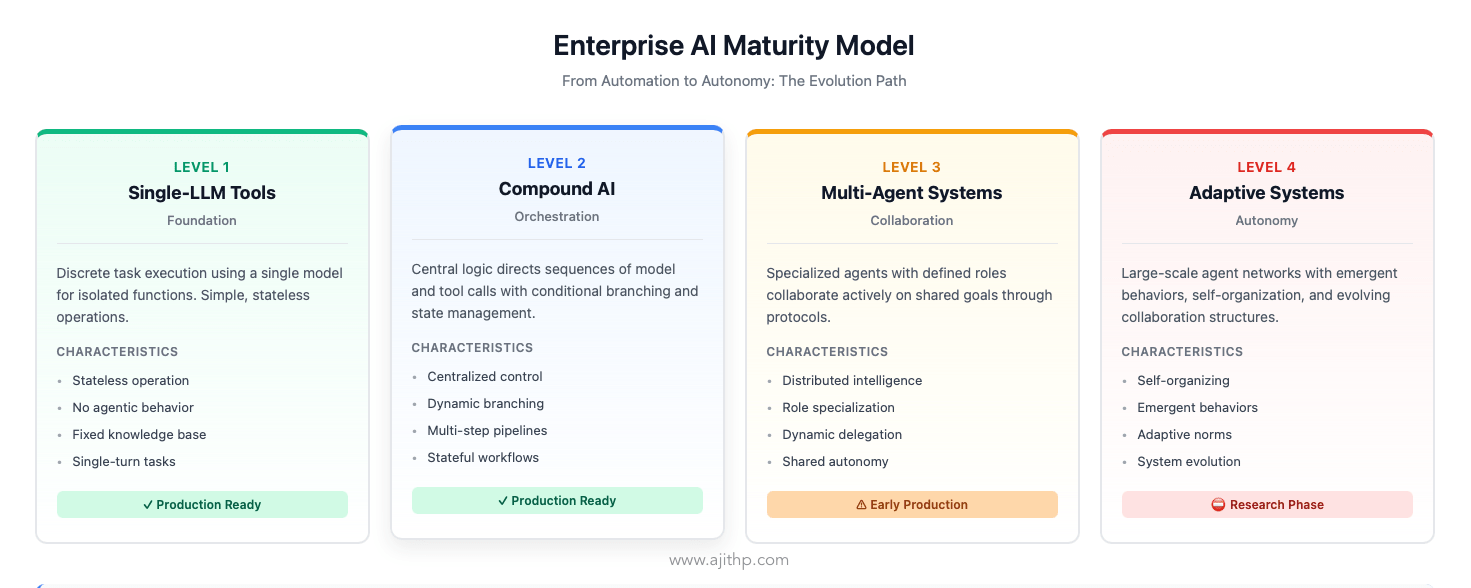
- Level 1: Single-LLM Tools. This is the baseline, where a single LLM is used for a discrete task, such as a simple summarizer or a chatbot answering from a fixed knowledge base. The system is stateless and not agentic.
- Level 2: Orchestrated Workflows (Compound AI). At this level, a central logic, often implemented as a state machine or graph (e.g., using LangGraph), directs a sequence of calls to different models and tools. The workflow can be dynamic, with conditional branching, but control remains centralized. This represents the majority of current enterprise “agentic” deployments.
- Level 3: Collaborative Multi-Agent Systems (MAS). Here, a team of specialized agents with defined roles (e.g., Researcher, Writer, and Critic in a CrewAI setup) collaborates actively. They delegate tasks, share context, and coordinate their actions to achieve a common, high-level goal. Autonomy is shared among agents, but it is often directed by a lead agent or a predefined collaboration protocol.
- Level 4: Complex Adaptive Systems. This is still in a research phase and may be considered the logical endpoint of the agentic trend. At this level, a large number of agents can self-organize, form norms, and exhibit emergent, system-level behaviors that were not explicitly programmed. These systems, capable of learning and adapting their own collaborative structures, hold the potential to model and automate highly complex, dynamic environments, such as an entire economy or a social network.
The table below maps architectural complexity against production readiness, helping organizations assess current capabilities and plan phased adoption.
| Level | Name | Description | Key Characteristics | Production Readiness |
|---|---|---|---|---|
| Level 1 | Single-LLM Tools | Discrete task execution using a single model for isolated functions | • Stateless operation • No agentic behavior • Fixed knowledge base • Example: Simple summarizer or FAQ chatbot | Production ready Low complexity, predictable behavior |
| Level 2 | Orchestrated Workflows (Compound AI) | Central logic directs sequences of model and tool calls with conditional branching | • State machine or graph orchestration (e.g., LangGraph) • Centralized control flow • Dynamic branching based on intermediate results • Example: Document processing pipeline with extraction → validation → formatting | • State machine or graph orchestration (e.g., LangGraph) • Centralized control flow • Dynamic branching based on intermediate results • Example: Document processing pipeline with extraction → validation, → formatting |
| Level 3 | Collaborative Multi-Agent Systems (MAS) | Specialized agents with defined roles actively collaborate on shared high-level goals | • Agents delegate sub-tasks and maintain shared context through communication protocols • Role-based specialization (e.g., Researcher, Writer, Critic) • Coordination via lead agent or protocol (e.g., A2A) • Shared autonomy with structured collaboration • Example: Content generation team with research, drafting, and editorial agents | Early production Requires robust observability, governance frameworks, and runtime monitoring |
| Level 4 | Complex Adaptive Systems | Large-scale agent networks with emergent behaviors and self-organizing capabilities | • Self-organizing agent topologies • Emergent system-level behaviors • Adaptive collaboration structures • Learning and evolving coordination norms • Example: Economic simulation, autonomous supply chain network | Research Phase – No Production SLA Theoretical endpoint; not yet viable for mission-critical enterprise workloads |
Reality check: In enterprise architecture reviews, 80% of teams describe their system as “Level 3” when the architecture clearly shows Level 2 with extra prompts. This isn’t dishonesty. It’s vendors rebranding orchestration as “multi-agent” because it sounds more sophisticated.
The test: If your “lead agent” is generating every action sequentially, you’re at Level 2, not Level 3. True Level 3 agents delegate to autonomous executors that operate concurrently.
Key Insight: Most enterprises currently operate at Level 2, with leading organizations piloting Level 3 deployments in controlled environments. Level 4 remains a research frontier, and organizations should not roadmap production dependencies on these capabilities before 2027 at the earliest.
Anatomy of a Modern Compound AI Architecture
As enterprises develop sophisticated systems, a modular architectural pattern emerges, separating planning, execution, and cognitive functions like memory and tool use. Understanding this is key to designing scalable, maintainable, and governable AI systems.
Architecture Blueprint: A Modular Framework for Enterprise Agents
A typical modern compound or multi-agent architecture can be visualized as a layered system. At its core is the Orchestration and Planning Layer, which acts as the central nervous system. This layer receives a high-level goal and is responsible for decomposing it into a coherent plan. It then interacts with one or more Agent Kernels. Each agent kernel is an instantiation of an agent, equipped with its own instructions, state, and access to a suite of shared Cognitive Subsystems. These subsystems provide the foundational capabilities required for intelligent action: a Memory Subsystem for context and learning, a Tool-Use Subsystem for interacting with the external world, and a Retrieval Subsystem for accessing knowledge. Finally, a Communication Layer, governed by emerging protocols, facilitates the exchange of information between agents and between agents and tools. This modular design allows for specialization, reusability, and independent scaling of components.
The Central Nervous System: Planner and Orchestrator Models
The core component of a multi-agent system, often called the “brain,” handles task breakdown and coordination. Usually, a powerful LLM performs this role, but the method it uses greatly impacts the system’s overall efficiency and scalability. Two main approaches have developed: the Orchestrator and the Planner.

- The Orchestrator Model: In this simpler, centralized approach, a single LLM serves as an orchestrator, generating all the specific actions to be executed in a sequential or turn-based manner. It effectively micromanages the entire process, deciding step by step what each worker agent or tool should do. For example, it might first instruct a search agent to find data, then, after receiving the result, instruct a writer agent to summarize it. While straightforward to implement, this model can become a significant performance bottleneck, as the entire system must wait for the orchestrator to process each step before proceeding. It is also less effective at handling tasks that could be performed concurrently
- The Planner Model: A more advanced, efficient approach involves an LLM serving as a high-level planner. Instead of generating specific actions, the planner creates a strategic plan that outlines the sub-tasks, their dependencies, and the agents responsible for them. This plan is then distributed to multiple executor agents, which can generate their own actions and execute their assigned sub-tasks independently and, where possible, concurrently. The planner only intervenes to re-evaluate the plan when a significant event occurs, such as the completion of a major milestone or an unexpected failure. Experiments demonstrate that the planner model significantly outperforms the orchestrator model in handling concurrent actions, leading to improved efficiency and better utilization of agents. The industry’s evolution toward the planner model is a key trend for 2024-2025, as it enables more scalable, resilient, and cost-effective multi-agent systems.
| Choose an Orchestrator architecture when: | Choose a Planner architecture when: |
| The workflow has strictly sequential dependencies where each step requires the output of the previous step | The workflow contains three or more independent sub-tasks that can execute concurrently |
| Sub-tasks are simple and fast-executing (orchestration overhead is negligible) | Sub-tasks have minimal dependencies (e.g., parallel data enrichment from multiple sources, simultaneous compliance checks) |
| Process is deterministic with minimal branching logic | Latency reduction is critical to user experience or operational efficiency |
| Example: Document approval workflow with mandatory step-by-step review gates | Example: Processing a loan application requiring simultaneous credit bureau checks, employment verification, and asset valuation |
Cognitive Subsystems: Advanced Memory, Tool-Use, and Retrieval Architectures
For an agent to act intelligently, it also needs cognitive capabilities to remember, access knowledge, and interact with its environment. These are provided by dedicated subsystems.
Memory Architectures
Memory is the critical component that allows agents to maintain context, learn from experience, and perform tasks beyond a single interaction. Modern systems employ a multi-layered memory architecture.

- Short-Term Memory: This corresponds to the information held within the LLM’s context window. While context windows have expanded dramatically (e.g., over 1 million tokens for some models), this memory is ephemeral and finite.
- Long-Term Memory: To persist information beyond a single session, systems use external storage, typically vector databases. Knowledge is retrieved from this long-term store using Retrieval-Augmented Generation (RAG) techniques, allowing an agent to access a vast repository of information.
- Procedural Memory: This is an emerging and crucial capability for true automation. It involves the system learning from the execution traces of past tasks. By storing successful (and unsuccessful) workflows, the agent can learn to solve similar problems more efficiently in the future, effectively building up a library of skills. Frameworks like LEGOMem are exploring how to decompose these past trajectories into reusable memory units.
- Heterogeneous Memory: A key architectural consideration for multi-agent systems is the recognition that a single, shared memory pool can dilute the expertise of specialized agents. The concept of heterogeneous memory proposes that each agent should maintain its own distinct, structured memory aligned with its role. A “database agent,” for example, would maintain a memory of successful SQL queries and schema information, while a “writing agent” would remember stylistic guidelines and previously generated content.
Tool-Use Subsystem
The tool-use subsystem serves as the agent’s interface to the external world, allowing it to transition from reasoning to taking actions. Tools are predefined functions that agents invoke to complete specific tasks, such as web searches, database API calls, code execution, or software application interactions. Successfully selecting the appropriate tool for each sub-task and supplying the correct parameters is key to an effective agent system. Designing clear and descriptive tool interfaces is equally important as designing the agents themselves because an inadequately described tool can lead an agent astray.
Retrieval Architectures: RAG and GraphRAG
While RAG has become the standard pattern for grounding LLMs in private enterprise data, its reliance on semantic similarity search has limitations. It struggles with “global questions” that require synthesizing information from across an entire document set, as it only retrieves the most similar chunks of text.
To address this, Microsoft has introduced GraphRAG, a significant evolution of the retrieval paradigm. The GraphRAG process works in two main stages:
- Index Construction: An LLM first reads all source documents to extract entities and their relationships, building a comprehensive knowledge graph. This graph is then analyzed to identify and summarize “communities” of densely connected information at various hierarchical levels.
- Query Time: When a user asks a question, the system can query this structured graph to find highly relevant and interconnected information. For global questions, it uses a map-reduce approach across the pre-computed community summaries to synthesize a comprehensive answer that reflects the entire dataset.
This approach allows GraphRAG to answer complex questions about themes, relationships, and patterns across large data collections where baseline RAG often fails.
Communication and Collaboration: Agent Protocols, Context-Sharing, and Delegation Logic
In a multi-agent system, effective communication is essential for agents to operate successfully. One significant challenge is known as the “disconnected models problem,” in which agents lose context between interactions. This can result in duplicated efforts and incoherent strategies. To address this issue, the industry is increasingly focused on standardizing agent communication.
Two key protocols are emerging as foundational standards:
- Model Context Protocol (MCP): Introduced by Anthropic, MCP is an open standard for model-to-tool communication. It defines a standardized way for an AI model or agent to discover the capabilities of external tools (like APIs or databases), provide them with context, and receive structured data in return. It acts as a universal adapter, abstracting away the complexity of custom API integration
- Agent2Agent (A2A) Protocol: Initially developed by Google and now managed by the Linux Foundation, A2A focuses on agent-to-agent communication. It is a task-oriented protocol that enables agents to discover one another, delegate tasks, and collaborate on complex, long-running workflows. It supports multi-modal interactions and provides a robust framework for managing collaborative sessions between autonomous entities.
If you’re interested in exploring MCP in detail, please read this article.: Model Context Protocol (MCP)- The Integration Fabric for Enterprise AI Agents
Many think that MC P and A2A protocols are competitors; in fact, these protocols complement each other, forming a layered communication stack.An agent might use MCP to interact with its tools (vertical communication) and A2A to collaborate with other agents (horizontal communication). The adoption of this protocol stack is a crucial development because it enables a truly interoperable ecosystem of agents and tools, similar to how HTTP and TCP/IP powered the web. This separation of agents, tools, and orchestration logic prevents vendor lock-in and allows enterprises to develop a more flexible, modular, and future-proof AI infrastructure.
Beyond protocols, the challenge of delegation and context sharing is still significant, often addressed with advanced prompt engineering. A lead agent needs to break down a task and give each sub-agent a clear goal, necessary context, an explicit output format, and instructions on tool usage, while also setting boundaries to avoid overlapping work.
System Topologies: A Comparative Analysis of Centralized vs. Distributed Frameworks
The organizational structure, or topology, of a multi-agent system dictates how agents interact and has a major impact on its performance, scalability, and complexity.

- Centralized / Hierarchical Topology: In this model, a “supervisor,” “manager,” or “orchestrator” agent sits at the top, decomposing high-level goals and delegating sub-tasks to a team of “worker” agents. The workers may report back to the supervisor, who then synthesizes their outputs. Frameworks like AgentVerse and ChatDev employ this structure. This topology is easier to control, monitor, and debug, as there is a clear chain of command. However, the central agent can become a performance bottleneck, and the system is less resilient to the failure of that central node.
- Decentralized / Flat Topology: Here, agents interact as peers in a network, without a central authority. Communication can be one-to-one, one-to-many (broadcast), or managed through a shared space like a “blackboard”. The CAMEL framework is an example of this approach. This topology is more resilient and scalable, and can support more dynamic, emergent forms of collaboration. However, it introduces significant challenges in achieving coherent coordination, avoiding task duplication, resolving conflicts, and maintaining a shared understanding of the overall goal.
- Linear / Pipeline Topology: This is a simpler structure in which agents are arranged in sequence, with the output of one agent becoming the input to the next. MetaGPT, which simulates a software development waterfall process, is a prime example. This topology is highly effective for well-defined, sequential workflows where tasks have clear dependencies. Still, it lacks the flexibility to handle more complex, dynamic problems that require parallel execution or iterative feedback loops.
The Enterprise Integration and Application Layer
The real potential of compound AI is realized when it is fully embedded within an enterprise’s core operational fabric. This involves going past isolated agent-based applications to develop systems capable of accessing and updating enterprise record systems, analyzing large volumes of private data, and engaging with virtual representations of physical assets processes.
Connecting to the Core: Patterns for Integration with ERP, CRM, and Data Lakes
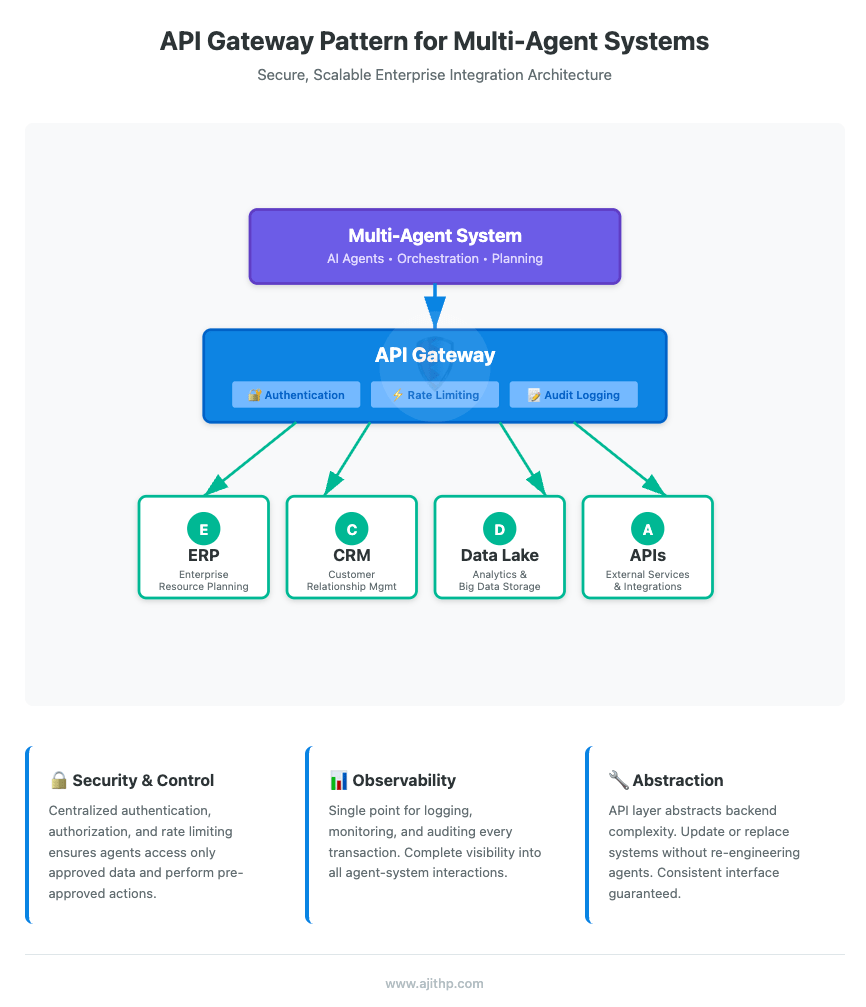
Integrating agentic systems with core enterprise platforms such as ERP, CRM, and data lakes requires a security-first approach due to its high-stakes nature. Direct database access is rarely advisable due to security risks and the brittleness of such connections. Instead, the dominant and recommended pattern is API-led connectivity
In this pattern, a curated, secure API gateway serves as the sole intermediary between AI agents and backend systems. This approach provides several key advantages:
- Security and Control: The API layer enforces authentication, authorization, and rate limiting, and makes sure that agents can access only specific data and perform pre-approved actions.
- Abstraction and Stability: The API abstracts the complexity of the underlying legacy systems. Even if a backend system is updated or replaced, the API contract can stay consistent, avoiding the need to re-engineer the AI agents.
- Observability and Auditing: All agent interactions with enterprise systems are funneled through the API gateway, thus creating a centralized point for logging, monitoring, and auditing every transaction.
By using this pattern, enterprises can build powerful cross-functional workflows. For example, an agentic system could monitor an ERP for supply chain disruption alerts, automatically query the CRM to identify all customers whose orders are affected, access a data lake for historical shipping data to predict the delay, and then draft personalized notification emails for each customer, placing them in a review queue for a human operator.
The Knowledge Fabric: Fusing Knowledge Graphs, RAG, and Agents
For agents to perform advanced reasoning, they need access to high-quality, contextual knowledge rooted in the enterprise’s specific domain. Combining knowledge graphs, Retrieval-Augmented Generation (RAG), and agent-based frameworks creates a strong “knowledge fabric” that makes this possible.
The GraphRAG pattern, pioneered by Microsoft, is an example of this fusion architecture. Instead of treating enterprise documents as a flat collection of text chunks for vector search, this approach first uses an LLM to parse the documents and build a structured knowledge graph. This graph explicitly maps the entities (e.g., projects, people, products) and their relationships.
When an agent needs to answer a question, it can now leverage this structured knowledge in several ways:
- Graph-Aware Retrieval: The agent can traverse the graph to find interconnected pieces of information that would be missed by a simple semantic search, leading to a more comprehensive and accurate context.
- Global Summarization: The system can use the graph’s community structure to provide the agent with summaries of key themes and topics across the entire dataset, enabling it to answer “global questions” that require a holistic understanding.
By feeding rich, structured knowledge graph context into an RAG-enabled agent, the system’s reasoning capabilities are significantly enhanced. The agent is no longer just retrieving facts but reason over a pre-processed map of the enterprise’s knowledge.
The Simulation Layer: Integrating Digital Twins for High-Fidelity Feedback and Decision Loops
The most sophisticated use of agentic AI is through its integration with Digital Twins. A digital twin is a real-time, virtual replica of a physical asset, system, or process that updates constantly with data from IoT sensors. The market for agentic digital twin platforms is expected to grow quickly, increasing from $5.6 billion in 2024 to $19.4 billion by 2034, indicating major enterprise investment in this technology.

The integration of agentic AI transforms a digital twin from a passive monitoring tool into an active, self-optimizing environment. This creates a powerful, closed-loop system for autonomous decision-making, particularly in asset-intensive industries such as manufacturing, logistics, and telecommunications. The integration pattern typically follows these steps:
- Perception: The agentic system observes the state of the real-world asset or process via the data flowing into the digital twin.
- Planning: The agent formulates a complex plan to optimize a key metric (e.g., re-routing a shipping fleet to avoid a storm, reconfiguring a factory floor for a new product).
- Simulation & Validation: Before executing the plan in the physical world, the agent runs it within the digital twin. This allows it to simulate the outcomes, identify potential risks or unintended consequences, and measure the projected impact on performance metrics in a safe, virtual environment.
- Refinement: Based on simulation feedback, the agent refines and optimizes its plan. This cycle may repeat multiple times until a satisfactory outcome is predicted.
- Execution: The validated and optimized plan is then executed in the real world, with the agent issuing commands to the physical systems.
This “simulate-then-act” approach significantly lowers the risk associated with deploying autonomous systems in high-stakes decisions and allows for ongoing, real-time optimization that cannot be achieved with human oversight alone.
Industry Use Cases
These architectural and integration patterns are already providing substantial benefits across multiple industries.
BFSI: Automated Advisory, Dynamic Risk Intelligence, and Continuous Compliance
In the Banking, Financial Services, and Insurance (BFSI) sector, agentic AI is being deployed to automate complex, knowledge-intensive processes, with a strong focus on fighting financial crime. The standard is shifting from AI as an assistant to a “workforce of AI agents” that can autonomously handle end-to-end workflows, yielding productivity gains of 200% to 2,000%. A key pattern is the use of multi-agent “squads”:
- Use Case: Automated KYC/AML Investigation. A “Data Pipeline Agent” monitors transaction data for anomalies. When an alert is triggered, a “RAG Agent” is dispatched to retrieve all relevant customer documents and public records. A “Research and Analysis Agent” synthesizes this information, analyzes transaction patterns, and drafts an investigation report. Finally, a “Critic Agent” reviews the report for completeness and accuracy before it is passed to a human compliance officer for final review. This entire process creates a fully auditable trail for regulators.
Healthcare: Advanced Clinical Reasoning and Patient Journey Optimization
In healthcare, agentic systems are improving clinical decision support and facilitating proactive, personalized patient care. By integrating with EHRs and remote monitoring devices, these agents can examine a patient’s full medical history and real-time vital signs to deliver timely insights.
- Use Case: Proactive Sepsis Detection. An agentic system continuously monitors patients’ vital signs and lab results in an ICU. Trained on vast datasets, it can detect subtle patterns indicative of early sepsis, often hours before human clinicians would notice. Upon detection, the agent can automatically alert the care team, pre-populate the patient’s chart with relevant data, and suggest the appropriate treatment protocol, thereby dramatically improving patient outcomes and reducing mortality rates. Other applications include optimizing patient journeys by automating appointment scheduling, managing chronic diseases through virtual health assistants, and accelerating clinical trial matching.
Public Sector: Proactive Citizen Services and Complex Decision Support
Governments are exploring agentic AI to improve the efficiency and quality of citizen services, freeing up civil servants to focus on more complex, human-centric work.
- Use Case: Automated Benefits Application Processing. A citizen interacts with a chatbot to apply for social benefits. A “Citizen Service Agent” guides them through the application and makes sure that all necessary information is collected. Once submitted, a “Document Assessment Agent” reviews the submitted documents for completeness and policy compliance, flagging potential discrepancies. A “Case Summary Agent” then synthesizes the applicant’s entire history and the submitted information into a concise brief for a human assessor. This automates the repetitive, time-consuming aspects of the process, reducing wait times and improving decision accuracy.
Frameworks, Platforms, and Tools: The Implementation Ecosystem
A vibrant and fast-moving ecosystem of frameworks, platforms, and tools supports the rapid evolution toward compound and multi-agent AI. This landscape is broadly divided between flexible, open-source orchestration frameworks that provide the building blocks for custom solutions, and integrated commercial platforms that offer production-grade capabilities with enterprise support. Choosing the right tools is a critical strategic decision that depends on an organization’s specific use case, existing technical stack, and desired level of control.
Open-Source Orchestration Frameworks
Open-source frameworks have played a crucial role in democratizing the development of agentic systems. They offer developers essential components for defining agents, managing their state, and coordinating complex workflows. Each top framework reflects a unique architectural philosophy, which makes them more suitable for specific kinds of problems.
Comparative Matrix: Key Agent Frameworks (2025)
The following table provides a structured comparison of the most prominent open-source frameworks, allowing technology leaders to map their requirements to the best-fit solution.
| Feature | LangGraph | AutoGen | CrewAI | DSPy |
| Core Architecture | State Machine (Graph-based) | Conversational (Group Chat) | Role-Based Orchestration | Declarative Pipeline (Compiler) |
| Coordination Model | Explicit state transitions, conditional logic | Natural language conversation between agents | Task delegation based on predefined roles | Programmatic chaining of optimized modules |
| Best For | Complex, branching, stateful workflows requiring precise control and error handling | Iterative, human-in-the-loop tasks like research, brainstorming, and code generation. | Simulating human team structures for well-defined business processes (e.g., content creation). | Optimizing the quality, performance, and reliability of LLM prompts and pipelines, not multi-agent orchestration itself. |
| Memory Support | Statompatrive-based with built-in checkpointing for persistence. | Supported through validation tasks and checkpoints, where a human can review an agent’s work before the next step proceeds. | Structured, role-based memory with short-term, long-term, and entity tracking capabilities. | Stateless by default; context and memory must be manually managed via retrievers or chained prompts. |
| Tool Integration | Extensive via the broader LangChain ecosystem. | Highly flexible, with tool use integrated naturally into the conversational flow. | Built-in integrations for common tools and services, with the ability to define custom tools. | Less focus on external tools; primarily concerned with optimizing the LLM’s reasoning process. |
| Human-in-the-Loop | Can be explicitly designed as nodes in the graph, allowing for human review and approval at critical steps. | Native and core to the design via the UserProxyAgent, which can act as a proxy for a human user to provide feedback or direction. | High for structured processes. Role-based design leads to more predictable, manageable workflows. | Not a primary design focus; evaluation and optimization are typically automated. |
| Production Readiness | Strong, due to its explicit state management, tracing capabilities, and deterministic control flow. | Moderate. The conversational nature can lead to unpredictable behavior or infinite loops without careful design and constraint. | High for structured processes. The role-based design leads to more predictable and manageable workflows. | High. Its compiler-based approach produces reproducible and optimized pipelines suitable for production deployment. |
Detailed Framework Analysis
- LangGraph: An extension of LangChain, is architected for problems where the process is complex. It represents workflows as a state graph, where nodes are functions (agents or tools) and edges define the transitions. This makes it exceptionally powerful for implementing complex business logic with loops, branches, and human-in-the-loop approval gates. Its explicit state management provides robustness and excellent debugging capabilities, but it comes with a steeper learning curve compared to other frameworks.
- AutoGen: A Microsoft framework designed for problems where the collaboration is complex and conversational. Its core paradigm is a “group chat” in which multiple agents (including human proxies) interact in natural language to solve a problem iteratively. This makes it highly effective for open-ended, exploratory tasks like research, brainstorming, or complex code generation, where the solution path is not known in advance. However, managing and constraining these conversations to prevent loops and ensure convergence can be challenging.
- CrewAI: This framework is optimized for problems where the organizational structure is key. It uses a simple, intuitive role-based model where you define agents with specific roles (e.g., ‘Researcher’, ‘Writer’) and tasks, and a central orchestrator manages the delegation and execution in a sequential or hierarchical process. This maps well to many real-world business processes and makes workflows easy to design and understand.
- DSPy: Standing for “Declarative Self-improving Language Programs,” DSPy takes a fundamentally different approach. It is not a multi-agent orchestration framework but rather a programming model and compiler for building and optimizing reliable LLM pipelines. Instead of manually engineering prompts, developers declare the modules of their pipeline (e.g., ChainOfThought, Retrieve), and the DSPy compiler automatically optimizes the prompts and even the model weights to maximize a given performance metric on a small set of training examples. DSPy is best used to build high-performance, reliable components (agents) that are then orchestrated by a framework such as LangGraph or CrewAI.
Commercial Platforms and Foundational Models
Alongside the open-source ecosystem, major technology providers are building integrated platforms and specialized models designed for enterprise-grade agentic AI.
- OpenAI’s Reasoning-Centric Models (o series): OpenAI’s strategy is evolving from creating powerful generalist models (like GPT-4o) to developing models specifically optimized for reasoning. The O model series is trained with large-scale reinforcement learning to perform complex tasks using an internal “chain of thought” process. This allows the model to “think before it answers,” leading to improved performance on multi-step problems and better adherence to safety policies. These models are ideal candidates for the central planner or orchestrator role in a compound AI system.
- Anthropic’s Multi-Agent Research and Principles: While not a commercial framework, Anthropic’s engineering team has published a highly influential set of practical principles for building effective multi-agent systems. Their key lessons, such as teaching the lead agent to delegate tasks with precise instructions, scaling the system’s effort based on query complexity, designing clear tool interfaces, and even using agents to improve their own prompts, provide a valuable, real-world playbook for any enterprise building these systems.
- NVIDIA’s Enterprise Stack (NIMs and NeMo Agent Toolkit): NVIDIA is leveraging its dominance in AI hardware to offer a full-stack platform for enterprise AI. NVIDIA Inference Microservices (NIMs) provide a standardized, optimized, and secure way to package and deploy AI models as containerized microservices, running on any GPU-accelerated infrastructure. Layered on top of this is the NVIDIA NeMo Agent Toolkit, an open-source framework designed to be the “connective tissue” for production-grade multi-agent systems. Its key differentiators are its framework-agnostic nature (it can orchestrate agents built with LangChain, CrewAI, etc.) and its first-class support for enterprise requirements, including observability, distributed tracing, and continuous evaluation.
- Microsoft’s Enterprise Tooling (Semantic Kernel and GraphRAG): Microsoft is focusing on tools that integrate deeply with the enterprise environment. Semantic Kernel is a model-agnostic, open-source SDK available in Python, C#, and Java, designed for building reliable AI agents and embedding them into enterprise applications. It features a robust plugin model that supports native code, OpenAPI specs, and the MCP protocol, making it highly extensible. Complementing this is GraphRAG, Microsoft’s proprietary, powerful approach to knowledge retrieval that provides a significant advantage for enterprises that need to reason over complex, unstructured private data.
Governance, Performance, and Enterprise Readiness
The shift to autonomous, multi-agent systems brings about new operational, security, and financial challenges that need to be tackled before these systems can be safely deployed at scale. Pre-deployment testing and traditional governance approaches are inadequate for systems that show dynamic, emergent behaviors during operation. Therefore, enterprise readiness relies on developing new governance frameworks, innovative performance metrics, and fresh models for cost management.
Governing Autonomy: Trust, Risk, and Security Management (TRiSM)
The autonomy and complexity of Agentic Multi-Agent Systems (AMAS) create unique risks that require a dedicated governance framework. The AI Trust, Risk, and Security Management (TRiSM) framework, when adapted for agentic systems, provides a structured approach around several key pillars.
- Explainability and Traceability: In high-stakes environments like finance or healthcare, it is not enough for an agentic system to produce the correct result; it must also provide a transparent, auditable trail of how it arrived at that result. This requires advanced observability tooling that logs every inter-agent communication, every tool call, the reasoning behind each decision, and any human-in-the-loop interventions. This complete audit trail is essential for debugging, compliance, and building trust in the system’s outputs.
- ModelOps for Agent Ecosystems: The operational challenge expands from managing the lifecycle of a single model to managing an entire ecosystem of agents, tools, and their interdependencies. This includes version control for agent prompts and tools, continuous evaluation of both individual agent performance and overall system collaboration, and secure deployment pipelines.
- Security for Compound Architectures: Agentic systems introduce novel attack surfaces. Adversaries can target the system through sophisticated prompt injection to manipulate an agent’s behavior, exploit coordination failures between agents to cause system-wide errors, or leverage an agent’s tool access for data exfiltration. Security measures must include sandboxing agent execution environments, implementing strict access controls on tools, and continuously monitoring for anomalous agent behavior.
- Runtime Governance: Perhaps the most significant challenge is that many risks associated with agentic systems, such as unexpected emergent behaviors, only become apparent during live operation. This necessitates a shift from pre-deployment governance (e.g., model review boards) to continuous, runtime governance. This may involve deploying “guardian” agents that monitor the system in real time, enforce safety policies, and trigger human intervention when predefined guardrails are breached. Establishing an “Agent Review Board” and tiered human-in-the-loop controls are practical steps toward achieving auditable autonomy.
Learn more about LLM Observability: LLM Observability & Monitoring: Building Safer, Smarter, Scalable GenAI Systems
Measuring Success: Performance Metrics for Coordination, Reasoning, and Reliability
Assessing a multi-agent system’s performance involves going beyond basic outcome metrics such as task accuracy. The quality of the collaborative process itself is a critical determinant of the system’s efficiency, cost, and reliability. New process-level metrics are emerging to capture these dynamics.
- Coordination Quality: To measure how effectively agents collaborate, two novel metrics have been proposed 81:
- Information Diversity Score (IDS): This metric analyzes the semantic content of inter-agent messages to determine if agents are contributing unique, valuable information or simply repeating each other. A low IDS indicates redundant communication and poor coordination.
- Unnecessary Path Ratio (UPR): This metric quantifies the amount of wasted effort in the system by identifying and measuring redundant reasoning paths. A high UPR suggests that agents are re-exploring the same solution paths, leading to higher costs and latency.
- Reasoning Depth and Coherence: This involves evaluating the logical soundness and complexity of the reasoning chains produced by agents. This can be assessed through human review or by using a powerful LLM-as-a-judge to score the quality of the intermediate reasoning steps against a predefined rubric.
- Reliability and Robustness: Performance must be evaluated under real-world conditions, including noisy data, intermittent tool failures, and unexpected environmental changes. New benchmarks, such as AGENTSNET, are being developed to test these core competencies at scale. AGENTSNET draws from classic problems in distributed systems (e.g., leader election, consensus) to measure an agent network’s ability to self-organize, coordinate, and communicate effectively under various network topologies and sizes. Traditional financial benchmarks are also being extended to include safety-aware probes that audit agent teams for risks specific to financial systems.
The Economic Equation: Resource Allocation, Optimization, and Cost Models
The economic viability of multi-agent systems is a significant concern for enterprise adoption. These systems are notoriously resource-intensive; internal data from Anthropic shows that multi-agent systems can use up to 15 times more tokens than a standard chat interaction for a comparable task. This is driven by the overhead of prompts, intermediate reasoning steps, and inter-agent communication.
- The “Communication Tax”: A significant portion of this cost comes from what can be termed a “communication tax,” the token cost associated with redundant or inefficient communication between agents. Analysis of existing frameworks shows that the rate of token duplication between the reasoning and verification steps can be as high as 86%. Optimizing this communication is therefore a top priority for making these systems economically feasible.
- Cost Models: Accurately modeling and predicting the cost of an agentic workflow is challenging because of its dynamic, non-deterministic nature. Enterprises must develop cost models that account not only for token usage but also for the computational cost of tool execution and the human cost of oversight.
- Intelligent Resource Allocation: A promising area of research is using LLMs themselves to optimize resource allocation within the system. This can take several forms:
- Model Routing: A “router” LLM can select the most appropriate and cost-effective model for each sub-task. A simple data extraction task might be routed to a small, fast model, while a complex reasoning task is sent to a powerful but more expensive model.
- Optimized Planning: Using a “planner” architecture that enables concurrent execution of sub-tasks can dramatically reduce overall latency and minimize the time agents spend idle, thereby improving the utilization of computational resources.
- Self-Organizing Systems: The frontier of this research involves agents that can self-manage resources based on a defined budget or even a simulated monetary system, learning to optimize their own architecture and communication patterns to maximize rewards while minimizing costs.
Strategic Recommendations and Outlook
The transition to compound and multi-agent AI is a strategic transformation and requires a fundamental rethinking of how AI initiatives are planned, delivered, and governed. Do not underplay this; do not bucket it into a standard technological upgrade. For enterprises to move beyond scattered experiments and achieve industrialized, scalable AI, leaders must adopt a new playbook focused on end-to-end process reinvention, cross-functional collaboration, and a disciplined, phased approach.
Enterprise Adoption Insights: From Experimentation to Industrialization

The initial wave of generative AI adoption was characterized by bottom-up experimentation and a focus on optimizing discrete tasks. To seize the advantage in the agentic era, organizations must pivot to a more strategic and industrialized model. Drawing on insights from McKinsey, this involves a transformation across four key dimensions :
- Strategy: From Scattered Initiatives to Strategic Programs. AI initiatives should be directly aligned with the most critical strategic priorities of the business, rather than pursuing a fragmented portfolio of tactical use cases. This involves shifting focus from incremental efficiency gains to exploring how autonomous systems can reimagine entire business functions, create new revenue streams, and develop sustainable competitive advantages.
- Unit of Transformation: From Use Case to Business Process. The approach must transition from simply integrating an AI tool into a single step of an existing workflow to reinventing the entire business process. The guiding question should evolve from “Where can I use AI in this process?” to “What would this process look like if autonomous agents managed 60% of it?” This requires a comprehensive rethinking of workflows, decision-making logic, and human-system interactions.
- Delivery Model: From Siloed AI Teams to Cross-Functional Squads. Successfully embedding agents within enterprise systems, processes, and data flows is too complex for isolated AI centers of excellence. Therefore, it is essential to adopt durable, cross-functional “transformation squads.” These teams should consist of business domain experts, process designers, AI engineers, IT architects, and data engineers working collaboratively from day one.
- Implementation Process: From Experimentation to Industrialized Delivery. The focus must shift from creating proofs of concept to designing scalable, governable, and economically sustainable solutions from the beginning. Unlike traditional IT projects, the ongoing operating costs of large-scale autonomous systems can surpass the initial investment. As such, designing for economic sustainability should be a primary consideration, not an afterthought.
Learn more about Enterprise Decision Velocity: The New Metric for Enterprise AI Success
A Strategic Roadmap for Building Compound AI Capabilities
For organizations embarking on this journey, a phased approach can help manage complexity and risk while building momentum and delivering incremental value.

- Phase 1 (Foundation): The focus in this initial phase is on readiness. This involves cleaning and structuring key data sources, establishing a robust, secure API layer for core enterprise systems, and identifying high-value, low-risk business processes ripe for automation.15 The first deployments should be simple Workflow Agents that automate well-defined, repetitive tasks, delivering quick wins and building organizational confidence.
- Phase 2 (Orchestration): In this phase, the organization begins to build true Compound AI systems. This involves selecting and standardizing on a core orchestration framework (e.g., LangGraph for process-heavy tasks) and developing internal expertise to build centrally controlled, multi-step workflows. A critical investment during this phase is in establishing a comprehensive observability and governance platform to monitor, trace, and secure these more complex systems.
- Phase 3 (Collaboration): With a solid foundation in orchestration, the organization can begin experimenting with true Multi-Agent Systems. This involves designing teams of specialized agents that can collaborate on more open-ended tasks. To ensure future flexibility and avoid vendor lock-in, this is the stage to adopt emerging communication protocols like MCP and A2A formally. Initial MAS deployments should favor structured, hierarchical topologies, which are easier to manage, before exploring more complex decentralized models.
- Phase 4 (Autonomy): This represents the frontier of enterprise AI. In this phase, validated multi-agent systems are integrated with Digital Twins of core business processes, creating closed-loop systems for autonomous optimization. Deploying agents in these high-stakes roles requires mature runtime governance capabilities and robust human-in-the-loop oversight mechanisms to ensure that all autonomous decisions are safe, compliant, and aligned with business objectives.
Future Trends: The Path to Self-Improving Systems and the “Economy of Minds”
Looking toward the latter half of the decade, several key research trends are poised to redefine the capabilities and architecture of agentic systems.
- Model-Native Agency: A significant design shift is underway from pipeline-based agency, where external code and logic orchestrate LLMs, to model-native agency. In this emerging model, core agentic capabilities such as planning, tool use, and even memory are being internalized within its parameters through advanced reinforcement learning techniques. Models like OpenAI’s GPT5 and DeepSeek’s R1 are early examples of this trend. This internalization promises to reduce architectural complexity, lower latency, and produce more fluid and capable reasoning, as the model learns to “think” and plan autonomously rather than being directed by an external script.
- Self-Organizing Systems: The next frontier in multi-agent research is the development of systems that can self-organize and self-optimize. This involves agents that can learn to dynamically form teams, allocate resources, and even evolve their own communication protocols to solve problems more effectively, significantly reducing the burden on human developers to design and manage these complex systems.
- The “Economy of Minds”: As a long-term vision, some researchers theorize the emergence of an “Economy of Minds,” where a large-scale network of specialized agents could operate within a simulated economic framework. In such a system, agents would bid for tasks, pay for computational resources, and collaborate or compete based on financial incentives. This could lead to emergent, market-like behaviors and a highly efficient, decentralized form of resource allocation and problem-solving.
While these future trends are still mainly in the research phase, they provide an exciting vision for the ultimate potential of agentic AI to create adaptive, intelligent ecosystems that can autonomously manage and optimize the most complex aspects of the digital enterprise.
Related Articles
- Model Context Protocol MCP The Integration Fabric for Enterprise AI Agents : Explores the MCP standard USB C for AI for securely connecting agents to tools and data essential for scalable decision workflows.
- LLM Observability and Monitoring Building Safer Smarter Scalable GenAI Systems A practitioner’s blueprint for creating trustworthy GenAI applications that endure in production critical when converting AI signals into decisions.
- AI Code Assistants Comprehensive Guide for Enterprise Adoption: Technical and strategic guidance on adopting AI-assisted development tools, with insights on embedding safety observability and adoption in workflows.
- AI Native Memory and the Rise of Context Aware AI Agents: discusses memory-enabled agents that build context over time, key for decision systems that need continuity, personalization, and long-term reliability.
- Neuro Symbolic AI Foundations Benefits and Real World Applications Shows how hybrid AI models enhance interpretability and reasoning bridging gaps between perception logic and decisions.
Conclusion
Enterprise AI is at a critical juncture where architectural choices can mean the difference between a 3× ROI and a write-off. The contrast between Compound AI and Multi-Agent Systems is significant; it’s about controlled orchestration versus autonomous collaboration, and predictable costs versus potential 15× token multiplication.
Three Critical Takeaways
1. Architecture Before Models – The bottleneck has shifted from model capability to governance infrastructure. Your observability platform, API security layer, and interoperability protocols (MCP, A2A) are now more important than which LLM you choose.
2. Start with Planner Architecture – If your workflow has three or more independent sub-tasks, planner-based coordination delivers a 40-60% reduction in latency compared to using orchestrators. This decision will influence every system you develop over the next two years.
3. Cross-Functional Teams or Failure – Siloed AI centers of excellence cannot build systems that integrate ERP, CRM, and digital twins. Success requires cohesive transformation teams that include business analysts, data engineers, AI specialists, and IT architects from the beginning.
Your Next Three Actions
Before your next board meeting:
- Validate your architecture literacy: Can your lead architect explain when to use a planner versus an orchestrator without consulting documentation?
- Audit your budget allocation: If <20% of your AI budget is allocated to observability and governance, your system won’t survive in production.
- Test your vendor claims: Ask for live observability dashboards showing real agent decision traces, inter-agent message logs, and cost breakdowns.
No dashboard = no production experience.
References
- Towards Resource-Efficient Compound AI Systems – arXiv, accessed October 25, 2025, https://arxiv.org/html/2501.16634v3
- Orchestrating Human-AI Teams: The Manager Agent as a Unifying Research Challenge, accessed October 25, 2025, https://arxiv.org/html/2510.02557v1
- Multi-Agent Code-Orchestrated Generation for Reliable Infrastructure-as-Code – arXiv, accessed October 25, 2025, https://arxiv.org/html/2510.03902v1
- Agentic AI Workflows: What They Are and How to Implement Them, accessed October 25, 2025, https://www.matillion.com/blog/a-guide-to-agentic-ai-workflows
- CrewAI vs LangGraph vs AutoGen: Choosing the Right Multi-Agent …, accessed October 25, 2025, https://www.datacamp.com/tutorial/crewai-vs-langgraph-vs-autogen
- NVIDIA NeMo Agent Toolkit: Building Production-Ready Multi-Agent …, accessed October 25, 2025, https://thegowtham.medium.com/nvidia-nemo-agent-toolkit-building-production-ready-multi-agent-systems-ef50aea69fc3
- AI Agents: Built to Reason, Plan, Act – NVIDIA, accessed October 25, 2025, https://www.nvidia.com/en-us/ai/
- The New Model Context Protocol for AI Agents – Evergreen, accessed October 25, 2025, https://evergreen.insightglobal.com/the-new-model-context-protocol-for-ai-agents/
- Evolution of AI Agent Communication Protocols | Dot Square Lab, accessed October 25, 2025, https://dotsquarelab.com/resources/comparing-ai-agent-communication-protocols
- Agent Communications toward Agentic AI at Edge – A Case Study of the Agent2Agent Protocol – arXiv, accessed October 25, 2025, https://arxiv.org/html/2508.15819v1
- TRiSM for Agentic AI: A Review of Trust, Risk, and Security Management in LLM-based Agentic Multi-Agent Systems – arXiv, accessed October 25, 2025, https://arxiv.org/html/2506.04133v3
- MI9 – Agent Intelligence Protocol: Runtime Governance for Agentic AI Systems – arXiv, accessed October 25, 2025, https://arxiv.org/html/2508.03858v1
- Oversight Structures for Agentic AI in Public-Sector Organizations – arXiv, accessed October 25, 2025, https://arxiv.org/html/2506.04836v1
- Seizing the agentic AI advantage – McKinsey, accessed October 25, 2025, https://www.mckinsey.com/capabilities/quantumblack/our-insights/seizing-the-agentic-ai-advantage
- How Enterprises Can Successfully Integrate Emerging Technologies into Their Workflows, accessed October 25, 2025, https://appinventiv.com/blog/integrating-emerging-technologies-for-enterprise-workflows/
- Multi-Agent Systems and Compound AI Systems – Hung Du, accessed October 25, 2025, https://hungdu.com/multi-agent-systems-and-compound-ai-systems/
- Agentic AI Needs a Systems Theory – arXiv, accessed October 25, 2025, https://arxiv.org/html/2503.00237v1
- AI Agents vs. Agentic AI: A Conceptual Taxonomy, Applications and Challenges – arXiv, accessed October 25, 2025, https://arxiv.org/html/2505.10468v1
- The Rise of Agentic AI: A Review of Definitions, Frameworks … – MDPI, accessed October 25, 2025, https://www.mdpi.com/1999-5903/17/9/404
- AI Agentic Workflows: Revolutionizing Business Automation in 2025 – Openxcell, accessed October 25, 2025, https://www.openxcell.com/blog/ai-agentic-workflows/
- AI agentic workflows: a practical guide for n8n automation, accessed October 25, 2025, https://blog.n8n.io/ai-agentic-workflows/
- What Are Agentic AI Workflows? – Quiq, accessed October 25, 2025, https://quiq.com/blog/ai-agentic-workflows/
- (PDF) Multi-Agent AI – ResearchGate, accessed October 25, 2025, https://www.researchgate.net/publication/392458562_Multi-Agent_AI
- Multi-Agent and Multi-LLM Architecture: Complete Guide for 2025 – Collabnix, accessed October 25, 2025, https://collabnix.com/multi-agent-and-multi-llm-architecture-complete-guide-for-2025/
- Beyond Static Responses: Multi-Agent LLM Systems as a New Paradigm for Social Science Research – arXiv, accessed October 25, 2025, https://arxiv.org/html/2506.01839v2
Discover more from Ajith Vallath Prabhakar
Subscribe to get the latest posts sent to your email.

You must be logged in to post a comment.