

Audio Overview
In 2023, Air Canada found itself in court over a customer service incident caused by its chatbot. A grieving passenger asked about bereavement fares, and the chatbot confirmed their availability. Trusting this information, the passenger booked a flight. When they later claimed a refund, the airline rejected it, as bereavement fares had been discontinued months earlier. The chatbot didn’t invent the rule; it simply retrieved an outdated policy that was once valid but no longer applied force.
The court found Air Canada responsible. The decision served as a wake-up call: companies can be held accountable for their AI assistants citing information that is technically correct but organizationally outdated.
This is the phenomenon we call Version Drift.
What is Version Drift
Version Drift happens when an AI retrieves a document, rule, or policy that a newer version has officially replaced. Unlike hallucinations, where the AI invents something untrue, Version Drift surfaces content that is accurate in isolation but no longer valid in the current context. Imagine asking your enterprise assistant, “What’s our remote work policy?” If both the 2023 and 2024 versions of the policy are in your knowledge base, the system might pull up the 2023 draft because it matches the wording more closely, even though the 2024 policy is the active one. The AI doesn’t recognize the difference, answers confidently, cites a legitimate source, and leaves you with the false impression that its answer is correct.
How It Differs from Hallucination and Data Staleness
It’s easy to confuse Version Drift with other AI failure modes, but the distinction matters.
- Hallucination is when the AI lies. It generates something with no grounding in the source material, like inventing revenue numbers for a quarter that hasn’t been reported yet.
- Data Staleness is when the AI is ignorant. The knowledge base hasn’t been updated with the latest information, so the AI has no way of knowing about new regulations or clinical guidelines.
- Version Drift is when the AI is confused. The correct data exists in the system, but the AI can’t tell which version is authoritative.
Hallucination = lie, Staleness = ignorance, Drift = confusion.
Why It Matters More Than Anyone Budgeted For
Most organizations have invested heavily in mitigating hallucinations through prompt engineering, grounding responses in documents, and adding fact-checking layers. They’ve also invested in reducing staleness with real-time feeds and faster ingestion pipelines. However, Version Drift still bypasses all these safeguards.
That’s because it isn’t about whether information exists or is real, it’s about governance. Enterprises operate with living documents: investment policies, clinical procedures, actuarial guidelines, and compliance frameworks. These documents undergo cycles of draft, approval, supersession, and expiration. If AI systems can’t distinguish between what is draft and what is in force, they risk exposing firms to compliance violations, legal liability, and reputational damage.
And unlike hallucination, which is often easy to spot, Version Drift is insidious. The AI cites a genuine policy with a plausible reference. Quality assurance teams may even sign off on it. Only later, when the error translates into a regulatory fine or a patient safety incident, does the damage become clear.
This is why Version Drift is the hidden risk no one budgeted for.
The Risk Landscape
Enterprises don’t operate in static worlds. In industries such as banking, insurance, and healthcare, rules and procedures are continually revised. Policies are updated quarterly, compliance guidelines shift with every new regulatory bulletin, and clinical protocols evolve as new evidence emerges. These industries are not slow-moving; they are active ecosystems where governance distinguishes between regular activities and potential existential threats.
That’s why Banking, Financial Services, Insurance (BFSI), and Healthcare are at the epicenter of Version Drift risk. In these sectors, using the incorrect version of a policy can result in multimillion-dollar fines, compromised patient safety, and regulatory penalties.
BFSI: When a “Trusted” Answer Violates Compliance
Consider a wealth management advisor using an AI copilot to prepare client recommendations. The advisor asks for “current investment suitability guidelines.” The retrieval system pulls a PDF that looks official, carries the right branding, and matches the query closely. Unfortunately, it’s last quarter’s version, superseded after regulators tightened rules on complex product disclosures.
The advisor, trusting the AI, makes client recommendations that are now out of compliance. Those recommendations flow into CRM systems, investor portfolios, and client communications. By the time compliance teams realize the error, the firm is already exposed to regulatory violations worth millions. The advisor can point to the AI system’s answer. The system can point to a “real” policy document. And yet, the recommendations are invalid because the wrong version of a policy was treated as authoritative.
Financial institutions face this exposure everywhere: suitability guidelines, trading procedures, underwriting standards, credit risk models. Each one evolves through a cadence of board approvals, supersession, and regulatory updates. When AI retrieves an outdated version, the institution has technically violated its fiduciary duty even if no malice or fabrication was involved.
Healthcare: Outdated Procedures as Safety Risks
The same pattern applies in healthcare, where policies serve as the foundation of patient care, rather than merely being compliance artifacts.
Imagine a clinical assistant AI designed to support hospital staff. A nurse asks for patient discharge instructions after knee replacement surgery. Both versions 3.1 and 3.2 of the Standard Operating Procedure exist in the hospital’s knowledge base. Version 3.1 lacks a new medication interaction check that was added in version 3.2 after reports of adverse reactions.
If the AI surfaces version 3.1, the discharge instructions look valid, complete, and credible. But they are wrong. A patient could be discharged with medications that dangerously interact. Even if caught before harm occurs, the hospital is exposed to liability claims, regulatory investigations, and reputational damage.
The risk is significant, as Clinical guidelines, formularies, and procedural SOPs are frequently updated in response to new research or regulatory rulings. Any lapse in version control at the AI retrieval layer introduces patient safety risks that no hospital board can afford to overlook.
The flip side is equally important. Enterprises that solve Drift earn regulators’ trust more quickly, face fewer compliance bottlenecks, and can adopt AI at scale with greater confidence. In finance, this means launching AI-driven advisory tools without fear of regulatory clawbacks. In healthcare, it means accelerating the safe use of AI at the bedside, backed by board and regulatory approval.
The Common Pattern
In these cases, the problem is not that AI lacks information or fabricates facts. But it cannot distinguish between drafts, outdated versions, and the current, approved source of truth. That inability creates a silent gap between compliance frameworks and AI retrieval systems.
Hallucinations erode user confidence but are often easy to spot. Staleness is frustrating but usually remedied by updating the data pipeline. Version Drift, however, slips past unnoticed until it manifests as a compliance breach, a lawsuit, or a safety incident.
This is why leaders, especially of highly regulated industries (BFSI and Healthcare), should not treat it as an engineering quirk. It is a systemic compliance failure mode that carries financial, legal, and ethical consequences.
Why Guardrails Fail
When enterprises first began deploying generative AI, the focus was on hallucinations. Teams invested in prompt engineering, added fact-checking steps, and even built red-teaming exercises to probe for nonsensical answers. Later, attention shifted to data staleness, with budgets poured into real-time ingestion pipelines and automated refresh cycles. These measures were necessary, however, they do not touch the problem of Version Drift.
Why Conventional Fixes Don’t Work
- Prompt engineering only shapes how the model expresses an answer. It cannot change whether the source itself is current or superseded. A beautifully engineered prompt will still surface the wrong policy if the retriever feeds it an outdated version.
- Post-generation fact-checking works only when content is fabricated or ungrounded. In cases of Drift, the model cites a real policy, complete with version numbers and official formatting. A fact-checker sees nothing wrong because the citation is valid—it just isn’t the right version.
- Fresh data feeds reduce lag between the external world and the enterprise knowledge base. But Drift is not about missing the newest version—it’s about failing to recognize that multiple versions coexist, and only one is authoritative. Without governance-aware retrieval, the old and new versions remain equally retrievable, and semantic similarity often favors the wrong one.
The Root Cause
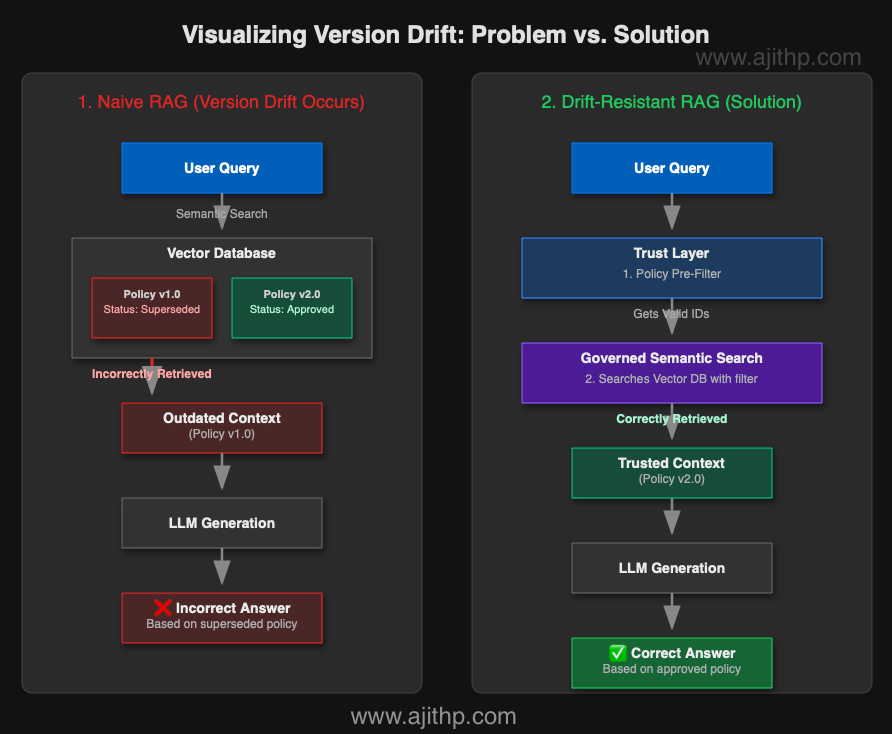
The real issue is architectural. Most Retrieval-Augmented Generation (RAG) systems were built to answer one narrow question: what is semantically most similar to the query? They are optimized to find matching text, not to enforce governance rules.
This is where deadly gap lies. A 2023 draft procedure may be semantically closer to a query than a 2024 approved policy, especially if it uses the same terminology. To a vector database, both look valid. To a regulator, only one is.
Introducing ContentOps
Solving Drift requires a new discipline: ContentOps. If MLOps governs the lifecycle of machine learning models, ContentOps must govern the lifecycle of enterprise knowledge. It means embedding document lineage, approval status, and effective dates directly into the retrieval process—not as optional metadata but as hard constraints.
Without ContentOps, enterprises are left with a brittle illusion of trust: systems that look reliable, cite official sources, and pass audits until the day a regulator or a patient’s family points out that the source was valid last year, but not today.
Version Drift slips past every guardrail designed for hallucinations or staleness. The only defense is to re-architect retrieval itself.
Just as MLOps governs the model lifecycle and DevOps governs the code lifecycle, ContentOps must govern the knowledge lifecycle. It is the essential third pillar for building trustworthy generative AI.
The Strategic Imperative
It may be tempting to treat Version Drift as a minor nuisance and call it just another wrinkle in AI retrieval. But in reality, it represents one of the most serious compliance blind spots that enterprises face today. The difference between an inconvenience and a crisis lies in governance. When an AI assistant pulls the wrong version of a document, it isn’t simply wrong, it may have violated the very rules that financial regulators, clinical boards, and insurance commissions are designed to enforce.
Why ContentOps Must Become a Core Discipline
Enterprises already recognize the importance of MLOps for predictive AI. Model drift, performance decay, and fairness checks are well understood, and organizations invest millions in monitoring and retraining their pipelines. Generative AI requires its own complement: ContentOps. As outlined earlier, ContentOps should not be considered optional; it must be elevated to a board-level discipline with dedicated funding, ownership, and accountability.
Without ContentOps, organizations fall into the dangerous assumption that “if it’s in the knowledge base, it’s safe to use.” This assumption is false. In regulated industries, the distinction between draft and approved, superseded and in force, expired and current is the difference between passing and failing an audit, between safe and unsafe patient care.
A Compliance Time-Bomb
Consider how the compliance framework operates. A bank’s lending policies are more than internal guidelines; they are legally binding interpretations of regulatory circulars. Similarly, a hospital’s discharge protocols are not merely notes but safeguards intended to prevent harm. When an AI presents an outdated version of these documents, it directly compromises compliance.
Don’t underestimate this as a hypothetical risk. Regulators don’t accept “the AI got confused” as an excuse. Liability flows directly to the institution. This can result in not only fines but also reputational damage, remediation costs, and a loss of customer trust, with the risks multiplying exponentially as enterprises rapidly adopt AI systems across their organizations.
In other words, if Drift is not addressed, it will become a compliance time bomb. The detonation doesn’t happen when the AI answers a question but when that answer is used in a real-world action, and the gap between “valid” and “superseded” is exposed.
The Agent Amplification Effect
The stakes become exponentially higher with the rise of autonomous AI agents. A chatbot can only answer a single question. A human may double-check, sense-check, or cross-reference. An agent, by contrast, takes action.
When an agent retrieves an outdated version of a policy and operationalizes it, that error propagates through multiple steps, downstream systems, and audit logs before anyone realizes the mistake.
Take the example of a financial services firm deploying an AI agent to update client risk profiles. The task is simple: read the “latest Q4 investment guidelines” and apply the new classifications to all Tier-1 client accounts. The agent dutifully retrieves the guidelines, but due to Version Drift, it pulls Q3 instead of Q4. Both documents exist, both look official, and both are semantically similar. The Q4 guidelines contain a new compliance requirement: a specific asset class must be flagged for enhanced due diligence. The Q3 version lacks this.
Unaware of the version mismatch, the agent proceeds to update thousands of records. It applies the outdated logic across the client base, writes audit trails, and generates summaries that look professional and complete. In minutes, the firm is left with systemic non-compliance across its portfolio. By the time compliance officers intervene, the damage is already done: remediation requires a manual review of thousands of accounts, regulatory exposure becomes unavoidable, and confidence in the AI platform is severely compromised.
This is the Agent Amplification Effect. A single retrieval error that a human might have caught turns into a systemic failure when an agent acts autonomously. The more steps the agent takes, the more opportunities for Drift to poison its reasoning. And the more integrated the agent is with enterprise systems, the broader the damage becomes.
Solving Drift doesn’t just prevent systemic errors; instead, it builds systemic trust. An agent that consistently acts in accordance with current policies becomes a force multiplier for compliance, rather than a liability. Executives who design governance-first systems turn AI into an asset that scales with confidence.
From Risk to Discipline
The only way forward is to elevate ContentOps from an afterthought to a first-class discipline. Just as no enterprise today would deploy predictive models without MLOps monitoring, no enterprise can afford to deploy generative AI without governance-first retrieval. Don’t view Drift as a rare edge case; it is an inevitable aspect of environments where policies are constantly evolving documents.
AI systems must be architected to enforce governance metadata before they even answer, not after. Otherwise, AI shifts from being an innovation engine to a compliance risk.
The Trust Layer Solution
If Version Drift is the hidden compliance time bomb, the Trust Layer is the fuse cutter. It is the architectural safeguard that prevents outdated or superseded knowledge from ever reaching an AI system in the first place.
The concept is simple yet powerful. Before an AI retrieves information, the system must first enforce governance rules (such as approval status, effective dates, version lineage, and access rights). Only once those checks are passed can the system perform a semantic search to find the most relevant answer.
This inversion of priorities to governance first, semantics second, is the key to eliminating Drift.
The Dual-Index Model

At the heart of the Trust Layer lies a dual-index design:
- Vector Index (Semantic Search)
- Stores embeddings of document content.
- Optimized to answer: “Which documents sound most similar to the query?”
- Excellent at capturing nuance in language and intent, but blind to compliance rules.
- Governance Index (Metadata & Lineage)
- Stores authoritative metadata: status, version, effective/expiry dates, supersession links, access control.
- Optimized to answer: “Which documents are valid, approved, and in force right now for this user?”
- Deterministic: either a document is current, or it is not.
The mistake of first-generation RAG systems was to rely solely on the Vector Index. The Trust Layer corrects that by binding the two systems together. The Governance Index determines what is valid. The Vector Index determines what is relevant. Only when both conditions are met does information pass through.
Policy-First Retrieval Flow
In this proposed architecture, the Trust Layer enforces a policy-first retrieval flow with three stages:
- Governance Filter
- The system queries the Governance Index first: “Which documents are approved, not superseded, effective as of today, and accessible to this user?”
- This produces a curated list of valid document IDs. Anything else is excluded, no matter how semantically close it might appear.
- Constrained Semantic Search
- The user’s query is embedded, and the Vector Index searches only within the pre-approved list of documents.
- Superseded drafts and expired policies are never even considered.
- Metadata-Aware Ranking
- Among the valid, relevant documents, the system can boost more recent versions, higher-authority owners, or jurisdiction-specific policies.
- The output is not just semantically accurate—it is also compliant by design.
This simple inversion filter, applied before ranking, will ensure that Drift is eliminated at its root.
This three-stage flow eliminates Drift by design. For a comprehensive technical blueprint, including component diagrams, API contracts, and implementation checklists, download the full white paper.
Fail-Safe by Design
Another principle of the Trust Layer is fail-safe behavior. If the Governance Index cannot confirm which documents are valid, the system fails closed. Instead of risking the retrieval of a superseded document, it responds: “I cannot verify the current policy at this time.”
This may feel inconvenient in the moment, but it preserves the most critical asset in enterprise AI, which is trust. For compliance-heavy environments, it is better to offer no answer than a wrong answer with confident citations.
Human Analogy
Consider the behavior of a diligent employee. If handed two policies, “Investment Guidelines 2023” and “Investment Guidelines 2024,” they instinctively check which one is the latest. They review approval stamps, effective dates, or even consult with a supervisor. A naïve RAG system lacks this instinct; it only cares which text looks most similar to the question. The Trust Layer teaches the AI to behave like a careful employee: always check which version is valid before answering.
The Simplified Architecture
Here’s a conceptual diagram to visualize the Trust Layer:

Many of you might think we’re adding more complexity to an already intricate system, but the benefits outweigh the challenges. It’s about integrating compliance logic as a fundamental aspect of the system’s structure, ensuring the AI never encounters content it shouldn’t see.
Why you need Trust Layer
For CIOs, CROs, and compliance executives, the Trust Layer represents a fundamental shift. With this approach, governance is embedded in the retrieval architecture itself, rather than being a post-hoc process.
This means:
- Superseded policies are architecturally excluded.
- Effective dates are enforced automatically.
- Unauthorized users cannot access restricted documents.
- Every answer can be audited against the governance rules that shaped it.
In short, the Trust Layer turns the retrieval process into a compliance-enforcing workflow rather than a compliance-risking shortcut.
From Principle to Practice
Implementing a Trust Layer does not require rewriting entire systems. It can be layered onto existing RAG pipelines by:
- Integrating the enterprise content management system as the Governance Index.
- Ensuring ingestion pipelines write metadata and embeddings in lockstep.
- Adding a retrieval service that queries governance rules before hitting the vector store.
It’s less about technology choices and more about architectural sequencing. Governance first, relevance second.
The Bottom Line
Enterprises must no longer assume that semantic similarity guarantees validity. The implementation of the Trust Layer guarantees that an AI only accesses documents that are current, approved, and compliant with the business. This is the most crucial step toward making generative AI suitable for enterprise use, not merely for improving accuracy, but for making that accuracy trustworthy.
Case Studies
The best way to understand the stakes of Version Drift is to look at how it plays out in practice. Two industries (banking and healthcare) illustrate both the risks of Drift and the gains when the Trust Layer is applied.
Banking: The Lending Circular Mismatch
A large bank maintained both its 2021 and 2023 lending policy circulars in its knowledge base. Both carried the bank’s branding, both were official, and both contained similar language around risk ratings. When advisors queried their AI assistant for “current lending requirements for small business loans,” the system sometimes retrieved the 2021 version because its phrasing was more semantically aligned with the question.
The 2021 circular lacked new requirements mandated by regulators in 2023, particularly those related to collateral disclosures. Recommendations made using this version left the bank exposed to potential regulatory sanctions.
After deploying a Trust Layer, the results shifted dramatically. The Governance Index excluded the 2021 circular from retrieval once the 2023 version was marked “in force.” Advisors querying the same system now saw only the updated requirements. Internal evaluation metrics showed:
- Freshness@K (the proportion of top results that were the latest version) rose from 68% to 99%.
- Superseded Document Rate (the share of results citing obsolete versions) fell to near zero.
This improvement reduced compliance risk in loan recommendations, reassured regulators during audits, and increased advisor confidence in using the AI assistant.
Healthcare: From SOP v3.1 to v3.2
In a hospital setting, a patient discharge SOP for cardiac surgery was updated from version 3.1 to 3.2. The new version included an additional check for medication interactions after a series of adverse events. Unfortunately, both versions remained in the clinical document repository. When nurses asked the AI assistant for “post-op discharge instructions,” the system sometimes surfaced version 3.1.
If you look at this, you clearly know it’s not a hallucination. It was a Drift event. The answer appeared official, complete, and trustworthy until a compliance officer discovered that the medication interaction section was missing.
When the Trust Layer was applied, the Governance Index filtered out version 3.1 as superseded. The assistant reliably surfaced only version 3.2, with effective-date metadata attached. Hospital metrics showed:
- Freshness@K improved from 72% to 100%.
- Policy Conformant Rate (the percentage of AI outputs aligned with the latest approved procedures) rose from 82% to 99%.
The hospital board observed a significant decline in patient safety risks associated with outdated instructions, enabling the institution to demonstrate to regulators that its AI systems ensure compliance more effectively, structurally rather than merely procedurally.
The Lesson

Across industries, these stories demonstrated the impact of Version Drift, which creates invisible vulnerabilities, while the Trust Layer measurably reduces them. You noticed that by embedding governance into retrieval, enterprises shift AI from being a compliance liability to a compliance asset.
The Executive Playbook
You saw that Version Drift is a governance gap that exposes enterprises to fines, lawsuits, and reputational loss. Fixing it requires leadership support and oversight.
Here are the non-negotiables:
1. Run an Ambiguity Stress Test.
Challenge your systems with open-ended prompts, such as “What’s our current investment policy?” or “What’s the latest clinical discharge protocol?” If the AI cannot consistently surface the most recent approved version, you have a live Drift risk. Consider this your Compliance Fire Drill, where you identify weaknesses before regulators or patients do.
2. Budget for ContentOps as seriously as MLOps.
Your teams may already be monitoring the model drift. Now empower and educate them to monitor content drift. Educate your leaders, peers, and board members that ContentOps isn’t overhead. It’s the operating system for enterprise trust. Fund dedicated resources to track document lineage, enforce version states, and integrate governance into ingestion pipelines.
3. Demand governance-first retrieval from every vendor.
Don’t accept “semantic accuracy” as an answer. Ask your AI implementation teams how their platforms enforce effective dates, supersession, and access controls at the retrieval layer. If they can’t explain it, they’re selling you risk disguised as innovation.
If your AI can’t tell which document is the latest, it isn’t enterprise-ready. But if you can, you’re not just compliant, you’re ahead. You’ll be able to move faster, earn trust sooner, and scale adoption further than competitors still wrestling with Drift.
Leaders, if you act now, you will not avoid fines, bad press, or reputation loss. You will build AI systems that regulators, employees, and customers can trust.
Related Articles
- Decision Velocity: The New Metric for Enterprise AI Success Details the framework for measuring AI’s true business impact. It provides the “why” for solving architectural problems like Version Drift—because eliminating these risks is a direct prerequisite for achieving the speed and trust needed for high Decision Velocity.
- Microsoft’s Tiny Troupe: Revolutionizing Business Insights with Scalable AI Persona Simulations Explores the advanced, multi-agent systems that amplify the risks of Version Drift. This provides a concrete example of the “Agent Amplification Effect,” where a single retrieval error can cascade into systemic failure across automated workflows.
- The Miniature Language Model with Massive Potential: Introducing Phi-3 Provides a deep dive into the compact, powerful language models that often sit at the heart of RAG systems. This piece highlights that even the most advanced LLMs are vulnerable to Version Drift if the surrounding data retrieval architecture lacks governance.
Conclusion
Enterprises rushed to contain hallucinations and invested in real-time pipelines to fight staleness. Yet the most dangerous failure mode slipped through: Version Drift. Unlike lies or ignorance, Drift hides in plain sight, answers backed by real documents that look trustworthy, but are no longer valid.
A superseded lending circular can expose a bank to regulatory action. An outdated SOP can put patients at risk. An autonomous agent can propagate outdated rules across thousands of records before anyone notices. And when regulators, courts, or customers ask who is accountable, the answer won’t be “the AI.” It will be the enterprise.
But here’s the opportunity: enterprises that fix Drift first don’t just avoid fines. They build AI systems that regulators view as compliant by design, that employees trust enough to use at scale, and that customers believe in. Governance-first retrieval isn’t a cost—it’s a competitive advantage.
The path is clear. Treat governance as architecture, not process. Run stress tests. Fund ContentOps alongside MLOps. Demand Trust Layers in every AI platform you deploy.
Version Drift is the hidden risk executives didn’t budget for. Solved early, it becomes a trust advantage competitors can’t match. If your AI can’t tell which document is the latest, it isn’t enterprise-ready. If it can, you’re already winning.
Frequently Asked Questions
The architecture does introduce a pre-filtering step, which adds a small amount of latency. However, a query to a well-indexed relational or graph database for a list of valid IDs is extremely fast, typically in the low double-digit milliseconds. This is a predictable and minimal trade-off for gaining auditable, deterministic compliance. The cost of a single compliance failure or operational error due to Version Drift far outweighs the cost of this architectural component and its minor latency overhead
While most modern vector databases support metadata filtering, they are not optimized for transactional integrity, complex relational queries (like hierarchical policies), and strict consistency required for a governance system of record. Using a purpose-built relational or graph database for the Governance Index ensures that business rules are never “approximated” by an ANN algorithm and that the system of record for compliance is separate from the semantic search index. This “separation of concerns” is a robust engineering practice that uses the right tool for the right job.
A one-time backfill process is a necessary prerequisite. This typically involves a scripted workflow that connects to your source ECM or document system’s API. The script iterates through your documents, extracts the required governance metadata and lineage relationships for each one, and populates the Governance Index. Only after a document’s metadata is successfully stored in the Governance Index should its content be chunked, embedded, and indexed in the Vector Index
Yes, absolutely. This architecture is framework-agnostic because it focuses on modifying the retriever component. You can implement a custom retriever class within these frameworks. This custom retriever would contain the logic for the two-stage retrieval process: first, making a call to your Policy Decision Point or directly to the Governance Index to get the list of valid document IDs, and second, passing that list as a filter into the framework’s native vector store retriever.
Start with the data model. Before writing any code, convene a working group of compliance, legal, and engineering stakeholders to define and agree upon the authoritative schema for your governance metadata. The first and most critical step is to establish a “golden source” for this metadata and a clear process for maintaining its integrity. Without a trusted source of truth for document status, version, and lineage, no architecture can succeed.
Model drift usually refers to a model’s predictive performance degrading because of changing data patterns or the model being out-of-date with reality. It’s typically solved by retraining the model on fresh data. Version drift, in contrast, is about knowledge base content – not the model parameters – being outdated or having multiple versions. You handle it by curating and controlling the content your AI retrieves or references. So, while retraining a model might solve some stale knowledge issues for end-to-end trained models, in RAG systems you must also manage your document versions. In short: model drift = retrain your model; version drift = update and filter your content. They complement each other: we retrain models periodically and continuously update the retrieval index and use metadata filters to ensure answers reflect the latest truth
It can be challenging if documents aren’t managed. Start by leveraging any existing content management or records systems – they often have fields like version numbers or last updated date. If not, you may use heuristics: for example, document titles usually contain versions (“v2”, “final”, dates). Use text processing to extract those. You can also implement a convention that when uploading docs into the AI’s index, users must input an “approval date” or status. If some content has absolutely no metadata, you might treat it as untrusted by default (or assign it a very old date). Another approach is to integrate with the business process: e.g., when a policy is approved by compliance, have that event trigger the update of a central metadata registry that your AI references. It’s a bit of upfront work to get this plumbing in place, but it pays off. If totally in doubt, at least bias by file modified timestamps – it’s not perfect (an old doc copied anew might have a new timestamp), but it’s better than nothing. Also, de-duplicate aggressively: if the exact same text appears in multiple docs, keep one canonical copy with metadata and drop the rest. This reduces the version clutter.
If you have a strong document management practice (like every policy has one source of truth and old ones are archived), you’re ahead of the game. However, version drift can still sneak in via “shadow data”. Employees might have saved local copies, or excerpts of old policies might exist in emails or presentations that the AI ingested. Additionally, if your AI indexes employee communications or tickets, those may reference outdated rules (e.g., a Q&A from last year about a policy). So you need to extend governance to those less-controlled data sources. It’s worth doing a scan: feed your index to a script that groups documents by similarity and find clusters that could be versions of each other. You might discover duplicates or near-duplicates that should be cleaned. Even with reasonable document control, ensure your AI uses the official repository (and not a copy in a “downloads” folder). Many companies are surprised that, despite having an intranet site with the latest policies, users have stored older PDFs elsewhere, which were subsequently picked up by the AI. So yes, you should still implement the retrieval checks as a safety net. The good news is your metadata quality might be high if you have existing control – leverage that (for example, your policies likely have an ID or version number; feed those in). Consider this an “AI audit” of your knowledge management – it can actually reinforce good practices by highlighting instances where content governance wasn’t followed.
Discover more from Ajith Vallath Prabhakar
Subscribe to get the latest posts sent to your email.

You must be logged in to post a comment.