

Artificial Intelligence (AI) is increasingly becoming the backbone of scientific innovation. As AI systems evolve, their role in driving discoveries is expanding across various research domains. This article explores “The AI Scientist,” a framework that aims to automate the entire process of scientific discovery.
“The AI Scientist” framework combines sophisticated large language models (LLMs) with state-of-the-art AI tools to handle the complete research lifecycle. It covers all bases, from generating novel ideas to executing experiments and drafting comprehensive scientific papers. This could make research processes more accessible and speed up scientific progress like never before, potentially reshaping how we approach scientific inquiry and discovery in the coming years.
The Phases of “The AI Scientist”
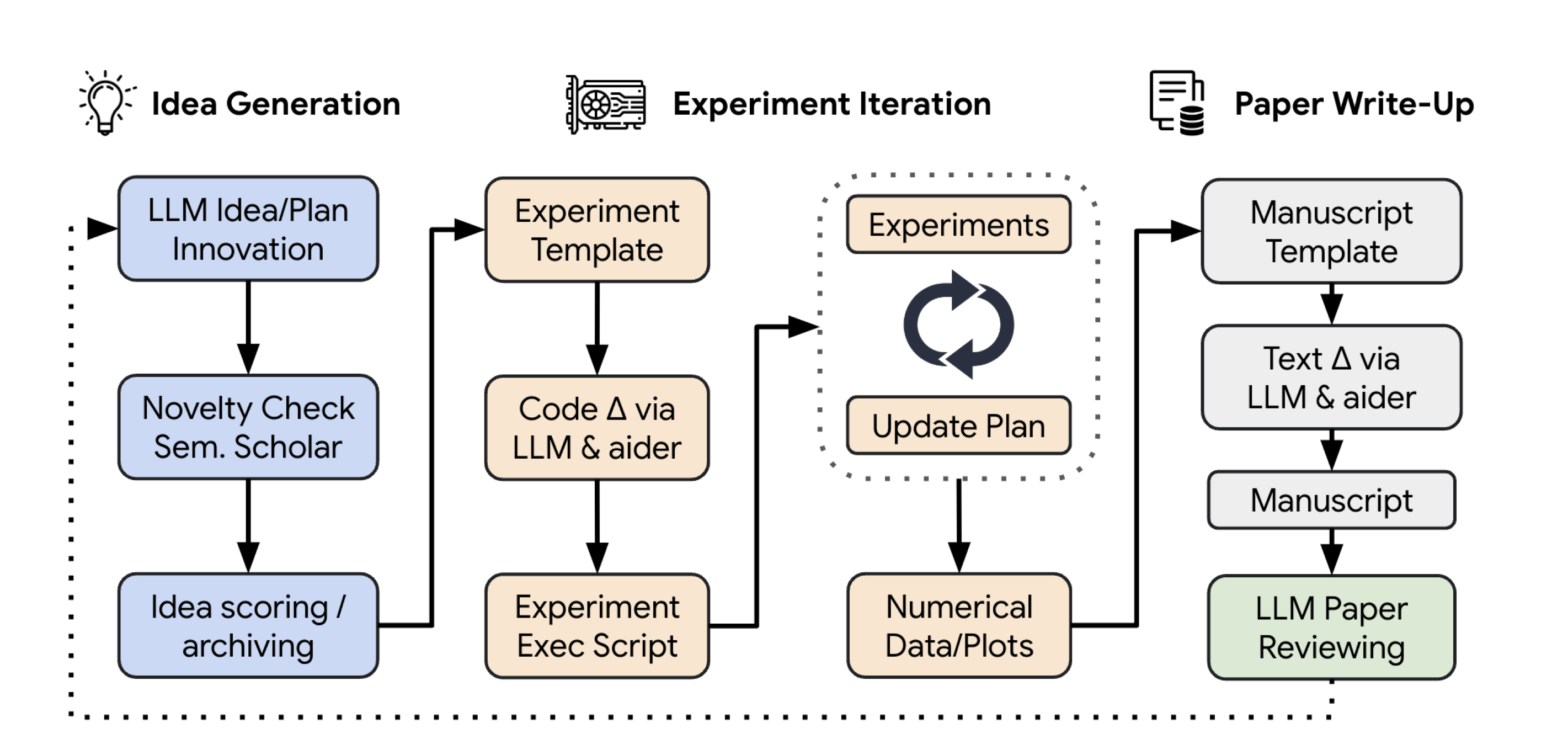
“The AI Scientist” is designed to completely automate the scientific discovery process. AI Scientist divides its research operations into three phases: Idea Generation, Experimental Iteration, and Paper Write-up. Each phase is critical in transforming an initial research concept into a complete scientific study. Let’s explore these phases here.
Phase 1 – Idea Generation
The Idea Generation phase is where the research process begins. Here, “The AI Scientist” uses Large Language Models (LLMs) to come up with a broad range of research ideas. These ideas are not just random thoughts; the AI carefully crafts them to be both innovative and feasible.
The AI is fed with a massive amount of existing scientific literature and data, which it analyzes to identify gaps in current knowledge or areas with potential for further exploration. The system uses techniques like chain-of-thought prompting, a method where the LLM breaks down the thought process into a series of logical steps. This helps it generate well-thought-out and logically sound ideas.
Evaluation
Once the ideas are generated, they are evaluated based on several criteria:
- Novelty: How new and original is the idea?
- Feasibility: Can this idea be realistically explored with the available tools and data?
- Potential Impact: What could be the significance of this idea if the research is successful?
Refinement
AI doesn’t stop generating and evaluating ideas; it refines them through self-reflection. This process involves revisiting and improving the generated ideas, similar to how a human researcher might reconsider and tweak their hypotheses.
This phase is crucial because a strong foundation, in the form of a well-developed research idea, sets the stage for the entire study.
Phase 2 – Experimental Iteration
Once a promising research concept is chosen, the next stage involves carrying out a series of experimental iterations. During this phase, the AI system will actively perform the necessary experiments to validate the proposed hypothesis.
Aider Coding Assistant
The AI uses a tool called Aider, an intelligent coding assistant, to write and modify the necessary code for the experiments. Aider can:
- Write Code: Automatically generate the code needed to run experiments.
- Debug: Identify and fix code errors to ensure the experiments run smoothly.
- Optimize: Improve the code’s efficiency, which is crucial for handling large datasets or complex computations.
Running Experiments
The AI then runs these experiments, collecting data and analyzing the results. Unlike a human researcher, who might take days or weeks to complete this process, the AI can do it much faster because it can automate every step, from setting up the experiment to analyzing the data.
Iteration
The AI Scientist continuously refines the experiments through multiple iterations. Each time an experiment is run, the system analyzes the outcomes and makes adjustments to improve accuracy and reliability. This iterative process ensures that the final results are robust and reliable.
This phase is akin to the lab work that human researchers conduct, except it’s done entirely by AI, making the process faster and often more thorough.
Phase 3 – Paper Write-up
Once the experiments are complete and the AI has gathered sufficient data, it moves on to the Paper Write-up phase, compiling its findings into a formal scientific paper.
LaTeX Template
The AI uses a LaTeX-based template, a standard tool researchers use to format scientific papers. This ensures that the paper is structured correctly according to academic standards, which is essential for publication in reputable journals or conferences.
Literature Review
The AI doesn’t just generate new findings; it also conducts a literature review to compare its results with existing studies. By using APIs such as Semantic Scholar, the AI searches for relevant papers and integrates them into the discussion. This step is crucial because it situates the new research within the context of existing knowledge, demonstrating how it contributes to or challenges what is already known.
Writing the Paper
The AI Scientist then writes the entire paper, including the introduction, methodology, results, discussion, and conclusion. It does so by organizing the data and insights from the experimental phase into a coherent narrative, just as a human researcher would.
This phase is where the AI showcases its ability to not only conduct research but also communicate its findings effectively, a key component of the scientific process.
Automated Reviewing
The next innovative aspect of “The AI Scientist” is its Automated Reviewing system, which ensures that the quality of the generated papers meets academic standards before they are submitted for publication.
How It Works
The AI uses LLMs to simulate the role of human reviewers. It evaluates the paper on several key criteria:
- Soundness: Are the methods and conclusions logically sound and well-supported by data?
- Presentation: Is the paper well-written and clearly organized?
- Contribution: Does the research make a significant contribution to the field?
- Overall Quality: How does the paper stack up against other research in the field?
Feedback Loop
The system provides feedback on the paper, which is then used to make further revisions if necessary. This may involve clarifying certain sections, correcting any errors, or strengthening the arguments. The objective is to ensure that the final paper is of high quality and ready for submission to a journal or conference.
The Authors of this paper agrees that, while the Automated Reviewing system is highly efficient, it’s not without limitations. The reason is it might miss nuanced issues that a human reviewer would catch, which is why continuous improvement and human oversight are still important. The system’s performance is constantly being evaluated and refined to improve its accuracy and reliability.
Advantages and Challenges
The Advantages
One of the most remarkable advantages of “The AI Scientist” is its scalability. By automating the processes of ideation, experimentation, and paper writing, it can explore a far broader range of research topics than any individual researcher could manage. This scalability is enhanced by the framework’s cost-effectiveness; generating research papers at a cost of approximately $15 each makes it accessible to a wide array of researchers and institutions. Additionally, “The AI Scientist” significantly accelerates the pace of discovery, reducing timelines from months or weeks to mere days or hours.
Other key advantages include:
- Consistency: The AI maintains a standardized approach across various research domains, reducing human-induced variability.
- 24/7 Operation: Unlike human researchers, the AI can work continuously without breaks, further accelerating research processes.
- Data Processing Capability: The AI can handle and analyze vast amounts of data more efficiently than humans, potentially uncovering patterns that might be missed otherwise.
- Reproducibility: The AI’s systematic approach enhances the reproducibility of experiments, a crucial aspect of scientific research.
The Challenges
Despite its many advantages, “The AI Scientist” faces several challenges. A primary concern is the quality of the generated research. While the system can produce innovative ideas and conduct thorough experiments, the results are not always flawless. Complex ideas may not be perfectly implemented, leading to errors or less-than-optimal outcomes.Furthermore, the automated paper-writing process, though impressive, can sometimes result in verbose or repetitive content that might not meet the rigorous standards of top academic publications.
Another significant challenge lies in potential biases. Like any AI system, “The AI Scientist” is only as reliable as the data it is trained on. If the underlying models or datasets contain biases, these could be reflected in the research outputs. Additionally, while the automated reviewing process is robust, it might overlook subtle errors or inconsistencies that a human reviewer could identify. This emphasizes the importance of continuous refinement and human oversight.
Additional challenges include:
- Ethical Considerations: The AI might propose or conduct research that raises ethical concerns, necessitating human oversight and clear ethical guidelines.
- Lack of Intuition: While the AI excels at data processing, it may lack the intuitive leaps that human researchers sometimes make, potentially missing groundbreaking ideas that aren’t obviously data-driven.
- Interdisciplinary Limitations: The AI might struggle with truly interdisciplinary research that requires connecting disparate fields in novel ways.
- Overreliance Risk: There’s a potential risk of over-relying on AI-generated research, potentially stifling human creativity and critical thinking in the scientific process.
- Adaptation to New Paradigms: The AI may struggle to adapt quickly to paradigm shifts in scientific thinking, as it’s trained on existing knowledge and methodologies.
Addressing these challenges will be critical for the continued development and adoption of “The AI Scientist” in the scientific community.
Training and Methodologies
“The AI Scientist” draws on a wide range of data sources to train its models, including extensive text corpora for the LLMs, code repositories for Aider, and domain-specific datasets for its experiments. The training process is iterative, with the system constantly refining its research methodologies and enhancing its performance.
Advanced methodologies are employed throughout the framework to ensure the quality of its outputs. During the idea generation phase, for example, chain-of-thought prompting breaks down complex ideas into manageable steps. In the experimental phase, Aider’s iterative debugging capabilities enable quick identification and resolution of errors, allowing research to proceed smoothly. Finally, during the paper write-up phase, the system incorporates a feedback loop to review and refine drafts, reducing the likelihood of errors and enhancing clarity.
Evaluation and Performance
To assess the performance of “The AI Scientist,” its outputs were compared to traditional, human-led research across various benchmarks. The findings were encouraging: “The AI Scientist” consistently produced innovative ideas and conducted experiments that matched or even surpassed the quality of human-led research in several instances. For example, the dual-scale denoising model discussed earlier outperformed existing methods on key metrics, underscoring the framework’s potential.
The automated reviewing system in “The AI Scientist” deserves a special mention. This system uses LLMs to evaluate the quality of generated papers and scores research based on soundness, presentation, contribution, and overall quality. During tests, the automated reviewer demonstrated almost human-level accuracy and provided valuable feedback that greatly enhanced the final research outputs. However, there is still potential for improvement, especially in dealing with more subtle aspects of paper evaluation, like identifying minor errors or inconsistencies.
Conclusion
“The AI Scientist” is an exciting new tool that changes how we do scientific research. It uses AI to come up with new ideas, run experiments, and write research papers – all much faster and cheaper than usual. This could help more people get involved in science and speed up new discoveries. It’s amazing to see how AI can make such a big difference in research, opening up new possibilities for learning about our world.
As “The AI Scientist” continues to develop, it’s crucial to address the ethical concerns around its use. Making sure it operates transparently and responsibly is key to prevent misuse and maintain scientific integrity. Future improvements should focus on enhancing accuracy, minimizing biases, and expanding the system’s ability to handle more complex, real-world data. This approach will help maximize the benefits of AI in science while ensuring careful and responsible implementation.
Additional considerations
- Human-AI Collaboration: Exploring how “The AI Scientist” can best complement human researchers rather than replace them.
- Educational Impact: Discussing the potential use of this technology in scientific education and training.
- Policy Implications: Addressing the need for new policies and guidelines in academic and research institutions to accommodate AI-generated research.
- Long-term Vision: Outlining a roadmap for the future development of “The AI Scientist” and its integration into the global scientific community.
“The AI Scientist” marks a major advance in automated research. Despite challenges, it offers huge potential for accelerating scientific progress. By using AI to tackle complex problems, it could spark breakthroughs across various fields, from medicine to climate science. This technology may launch a new era of discovery, addressing some of the world’s most pressing issues.
Related Articles:
Explore how AI models are improving accuracy through advanced retrieval and generation techniques.
Discover LongRAG’s novel methods in AI-driven information retrieval and generation.
• Explainable AI: Importance, Techniques, and Applications
Understand the significance of explainable AI and its various techniques and applications.
• Neuromorphic Computing: How Brain-Inspired Technology is Transforming AI and Industries
Learn about neuromorphic computing and its impact on AI and various industries.
Key Links
Research Paper: The AI Scientist: Towards Fully Automated Open-Ended Scientific Discovery
GitHub Link: https://github.com/SakanaAI/AI-Scientist
AI Scientist Webpage : https://sakana.ai/ai-scientist/
Authors: Chris Lu, Cong Lu, Robert Tjarko Lange, Jakob Foerster, Jeff Clune, David Ha
Discover more from Ajith Vallath Prabhakar
Subscribe to get the latest posts sent to your email.

You must be logged in to post a comment.