Quick brief
Artificial intelligence is a broad field of systems that produce outputs toward objectives; machine learning is one way to build such systems by fitting patterns from data or feedback. Their usefulness depends on the task, evidence, people, and process around them, so examples in medicine, agriculture, finance, and energy are possibilities to evaluate rather than guaranteed outcomes.
Full analysis
Revised October 18, 2026.
Artificial intelligence and machine learning are often discussed together because they shape many modern products and research projects. The terms are related, but they do not mean the same thing, and neither describes a single technology. This guide starts with the basic distinction, then looks at examples across four fields, common ways of classifying AI, and four learning paradigms used in machine learning.
The examples are intended to make the concepts concrete. A possible use is not proof that a system works well in every setting. Data, evaluation, workflow, and human judgment all matter.
What is Artificial Intelligence?
There is no single definition used for every scientific and policy purpose. One useful, current policy definition comes from the OECD: an AI system is a machine-based system that, for explicit or implicit objectives, infers from the inputs it receives how to generate outputs such as predictions, content, recommendations, or decisions that can influence physical or virtual environments. Systems differ in how much autonomy and adaptiveness they have after deployment. This definition helps describe a broad family of systems; it is not a claim that all AI thinks like a person or learns in the same way. (OECD explanation of its updated definition)
Some AI systems use learned models. Others rely on rules, search, planning, or combinations of methods. A system can therefore be called AI without changing its behavior through experience each time it is used. A map route planner, for example, may combine search algorithms, road data, rules, and learned estimates of travel time. The label “AI” describes a broad area, not a guarantee of capability.
It is also tempting to compare AI with people by saying that software is faster, more efficient, or less error-prone. Those claims need a particular task and evidence. A model may process many images quickly and still miss an important case; a person may notice context the model was never designed to represent. The practical question is not whether a machine is generally better than a human, but whether a system performs a defined task reliably enough in the setting where it will be used, and how people handle its limits.
AI has contributed to work in fields such as physics and healthcare, and it appears in consumer products. Its presence alone does not tell us whether a use is beneficial. That depends on what the system does, what information it uses, how it is evaluated, and who is accountable for the outcome.
What is Machine Learning?
Machine learning (ML) is a family of methods within AI. Instead of writing every rule that maps an input to an output, a developer uses data or feedback to fit a model that captures patterns relevant to a defined task. Depending on the method and objective, a model may classify, predict a value, rank items, generate content, find structure, or choose actions.
For example, a model trained on labeled photographs may learn patterns that help distinguish cats from dogs in new photographs. The model does not learn in the human sense: people choose the task, collect or select data, define the training process, and test how well the result works. Its output is a computed result, not an explanation of the world by itself.
The phrase “learns from data” can also give the wrong impression that a deployed model continually changes. In many systems, training happens before deployment, and the model’s behavior remains fixed until people deliberately evaluate, update, and release a new version. Other systems may adapt or use feedback in operation, but that behavior must be established for the specific system. It should never be assumed from the word “AI.”
Reliable, relevant data matters, but data alone is not enough. The task definition, sampling, labels, model choice, evaluation, and deployment context all affect results. A well-organized data pipeline can help an organization prepare data; it cannot by itself make an unsuitable task or biased sample appropriate.
What is the Significance of AI and ML in Present Times?
Organizations explore AI and ML for many reasons: to analyze information, support a decision, automate a repetitive step, or create a new kind of interface. Adoption statistics need dates and definitions because “using AI” can mean anything from a small pilot to a system relied on in everyday operations.
For historical context, IBM’s 2021 Global AI Adoption Index reported that 43% of surveyed business IT decision-makers said their company had accelerated its AI rollout because of COVID-19. The online survey was conducted in April 2021 and included 5,501 respondents across the countries and regions described in its report. The result is a respondent-reported snapshot from that period, not a current adoption rate and not evidence that a given implementation succeeded. (IBM/Morning Consult, 2021 executive summary)
Here are several areas where AI and ML methods may be used:
- Healthcare: Models may help analyze images, organize records, or support research. A clinical result still depends on the device or model, intended use, validation, and the care process around it.
- Finance: Statistical and ML models may estimate risk, identify unusual patterns, or support analysis. A model’s output is not automatically suitable financial advice or an acceptable credit decision.
- Retail: Recommendation systems may rank products using signals such as a person’s prior interactions. The suggestions depend on the system’s design and data; they do not necessarily reflect what is best for a customer.
- Fraud review: Models can flag transactions for investigation. A flagged transaction is an indication to review, not proof of fraud, and a false alarm can inconvenience a customer.
- Data security: Automated analysis can help find patterns associated with suspicious activity. It does not guarantee that a breach will be detected before damage occurs.
These are possible uses, not promises that AI makes every process faster, more accurate, or safer. A real deployment needs an outcome that can be measured and a way to respond when the system is wrong.
What is the Difference Between Artificial Intelligence and Machine Learning?
AI is the broader field and category of systems; ML is one approach used to build some AI systems. AI can use rules or search without machine learning, while an ML model can be a component inside a larger product or workflow. The six comparisons below are teaching distinctions, not a claim that every system fits into only one column.
| Artificial intelligence | Machine learning |
|---|---|
| A broad area concerned with systems that produce outputs toward objectives. Such systems need not imitate human behavior. | A family of methods that fits patterns or functions from data or feedback for a defined task. People still design and evaluate the process. |
| May use rules, search, planning, learned models, or combinations of them. | May be used within an AI system; it is not the whole of AI. |
| An AI system can include software, data, interfaces, people, and operating procedures. | A trained model is one component and does not necessarily update itself when it receives a new input. |
| Autonomy varies by system and setting; human involvement is not excluded by the term AI. | Training and later updates follow a chosen lifecycle. Continuous learning is a design choice, not a default property. |
| Examples include game-playing software, voice assistants, driver-assistance and automated-driving systems, and route-planning applications; each may combine several methods. | Examples include recommendation, image classification, speech recognition, and forecasting models; their use does not make an entire product “ML only.” Reinforcement learning is one ML paradigm, discussed below. |
| AI includes approaches beyond ML. Deep learning is one subset of ML; natural language processing, robotics, and computer vision are fields or application areas that may use ML and other methods. | Deep learning is a family of ML methods using multi-layer neural networks. It is not synonymous with ML as a whole. |
Artificial Intelligence vs. Machine Learning
How are AI and ML Changing the World?
AI and ML are changing some everyday and professional workflows, but the effect varies by use. A device may recognize a face to unlock it; that one feature does not mean that every part of the device is AI, or that recognition is always the best way to protect access. The examples below show where methods may fit and where the limits matter.
Medicine and Healthcare
Healthcare includes many different tasks, from organizing appointments to interpreting images. It is too broad to say that the entire medical industry relies on AI. A model’s output can affect a patient, so evidence about the exact system and the exact intended use matters.
Diagnosis. An Agency for Healthcare Research and Quality (AHRQ) page on cognitive load and diagnostic accuracy summarizes a 2015 National Academy of Medicine estimate: diagnostic errors may contribute to about 10% of patient deaths. This is a dated estimate about diagnostic errors, not a claim that they were the primary cause of those deaths or that AI reduces the problem. (AHRQ, “Introduction to Diagnostic Errors,” in Cognitive Load Theory and Its Impact on Diagnostic Accuracy)
AI methods are being studied for medical-image analysis and other clinical tasks. One research example is segmenting glioma regions in brain MRI: the BraTS benchmark evaluates algorithms on this specific image-segmentation task. Segmentation outlines regions in an image; it does not by itself determine whether a tumor is benign or malignant or establish a diagnosis. (Menze et al., “The Multimodal Brain Tumor Image Segmentation Benchmark (BRATS)”)
To interpret a reported performance number, ask what condition was assessed, which patients and images were included, how the result was compared with a reference, and whether it was tested outside the development setting. A percentage without those details can sound more decisive than it is.
Robotic surgery. Software and machine-learning methods may support planning, image interpretation, or parts of a robot-assisted workflow. The phrase “robotic surgery” does not mean that a robot independently decides what operation to perform. Surgeons, equipment, the specific procedure, and the clinical workflow remain central. Claims about reduced trauma or faster procedures need evidence for the specific system, procedure, patient population, and workflow; they cannot be inferred from the term “robotic surgery.”
Precision medicine. Precision medicine uses information about a person and their disease to help tailor prevention, diagnosis, or treatment. Depending on the condition, relevant information may include genes, environment, lifestyle, and other clinical factors. It is not simply “generic medicine versus personalized medicine,” and AI is not required in every precision-medicine approach. The National Cancer Institute provides an accessible overview of the term. (NCI Dictionary: precision medicine)
A specific screening device. In 2018, the FDA granted a De Novo request for IDx-DR, later renamed LumineticsCore, a prescription retinal diagnostic software device. The FDA decision summary identifies its study target population as asymptomatic people aged 22 and older with diabetes who had not previously been diagnosed with diabetic retinopathy. The device is intended for healthcare providers to automatically detect more-than-mild diabetic retinopathy using a specified retinal camera. The summary also limits the device to this purpose: it does not screen for diabetes or detect other eye diseases, and patients with positive or no-result outputs need follow-up according to its labeling. This is a concrete example of an AI device evaluated for a defined use, population, and workflow—not a general FDA approval of “artificial technology” or permission to use any model for diagnosis. (FDA De Novo database record; FDA decision summary)
Drug discovery. Researchers can use computational methods, including ML, to screen or prioritize possible compounds and analyze biological data. A model’s prediction is a research lead, not proof that a compound is safe, effective, or ready to become a treatment. Those questions require experimental and clinical evidence.
Agriculture
Agriculture faces the practical challenge of producing food amid changing climate, resource, and market conditions. The UN’s 2022 population projections gave a medium-scenario estimate of 9.7 billion people in 2050, while noting uncertainty around future population paths. This is a dated projection, not a guarantee or a calculation of the food supply needed in every region. (United Nations, World Population Prospects 2022: Summary of Results)
Sensors, cameras, drones, and farm-management systems can collect information. They are not AI in themselves. When connected to suitable software and farm practices, their information may help a farmer evaluate conditions. The value depends on crop, soil, climate, connectivity, calibration, and the cost of acting on a recommendation.
Crop selection. Data about soil, weather, crop varieties, water availability, and local economics can help compare planting options. A recommendation does not guarantee a high-yield seed or maximum return; those outcomes depend on conditions beyond the model.
Monitoring. Computer vision can be used to examine crop images for signs of weeds, pests, or disease. A detection is a prompt for interpretation, not necessarily a diagnosis. Drones can survey fields, while any response—manual or automated—needs to fit the field conditions and the risk of applying the wrong treatment.
More precise water and pesticide application. GPS, imagery, and other measurements may help target irrigation or treatment to particular areas. Savings depend on the crop, equipment, field, comparison method, and what is counted as waste. More precise application can be a useful goal, but the magnitude of any saving must be established in a stated context.
Agricultural robots. Robots can assist with specific tasks such as monitoring or harvesting when the crop, machinery, and setting are suitable. Computer vision can be one part of recognizing plants or produce. Whether a robot harvests faster or more efficiently than people depends on the crop, task, equipment, field conditions, and comparison being made.
Soil monitoring and analysis. Sensors can measure properties such as moisture, temperature, and pH; other setups may estimate humidity or soil-carbon measures. Those readings may inform a decision, but interpretation needs calibration and local agronomic context. A system cannot prescribe the right intervention merely because it has collected soil measurements.
Weather information. Temperature, rainfall, humidity, and forecasts influence many farm decisions. Better local forecasts may help farmers plan, but they do not remove uncertainty. A 2015 FAO report says drought had an especially detrimental impact—around 90% of production losses—on agriculture in sub-Saharan Africa. The statistic is specific to that region and hazard; it is not a worldwide share of crop losses across all weather events. (FAO, climate-related disasters and food security)
Banking and Financial Institutions
Financial institutions may use AI for internal analysis, document handling, fraud review, and customer-facing tools or decisions. The examples below range from back-office support to systems whose outputs can affect customers.
Credit decisions. A model may help estimate risk or organize information considered in lending. That does not mean it will reduce fees or produce better interest rates. Credit decisions affect people’s access to money and require appropriate data, testing, oversight, and routes to understand or challenge decisions. A score or prediction should not be treated as the whole decision without considering its context and applicable requirements.
Mortgage and loan processing. Optical character recognition and language-processing tools can help extract information from forms and supporting documents. This can assist document handling, but extraction is different from deciding whether a person qualifies for a loan. Claims about shorter processing time should specify which steps are included, the comparison workflow, and how exceptions are handled.
AI-driven trading. Algorithms can analyze price histories, news, or sentiment signals and may execute trades automatically under a long- or short-term strategy. Predictions remain uncertain; historical patterns can change, and a model does not guarantee a profitable strategy. Automated trading also operates within market and organizational controls.
Risk management. Models can help monitor data and flag patterns that deserve review. Finding a possible risk is not the same as assessing its significance or mitigating it. People and processes still have to decide what to do, with thresholds and responsibilities that fit the institution.
Fraud detection and prevention. A system may compare a transaction with patterns and flag unusual activity. Unusual does not necessarily mean fraudulent. A false positive can block a legitimate purchase or create extra work for a customer, so review and correction matter alongside detection.
Personalized banking. An institution may use relevant account activity or stated preferences to tailor a service or recommendation through a website, interactive voice response (IVR) system, mobile app, or chatbot. Use of personal information should be appropriate to the purpose, clearly governed, and attentive to privacy and fairness. A social profile is not automatically a proper input for recommending a financial product.
Security. Biometrics or voice may participate in identity verification. A successful match is not the same as authorization for every transaction, and biometric systems can have security, privacy, accessibility, and error considerations. Authentication needs to be part of a broader security process.
Energy Sector
Energy systems must balance supply, demand, reliability, cost, and environmental goals. AI and ML can contribute to forecasting or monitoring tasks, but a prediction is not the same thing as operating a grid or generating energy. Decisions about infrastructure and dispatch remain tied to physical constraints and operational procedures.
Renewable energy. Weather forecasts and historical conditions can help estimate solar or wind generation. These estimates may help planners coordinate other resources, but actual grid operations depend on demand, available generation, transmission, storage, and operator decisions.
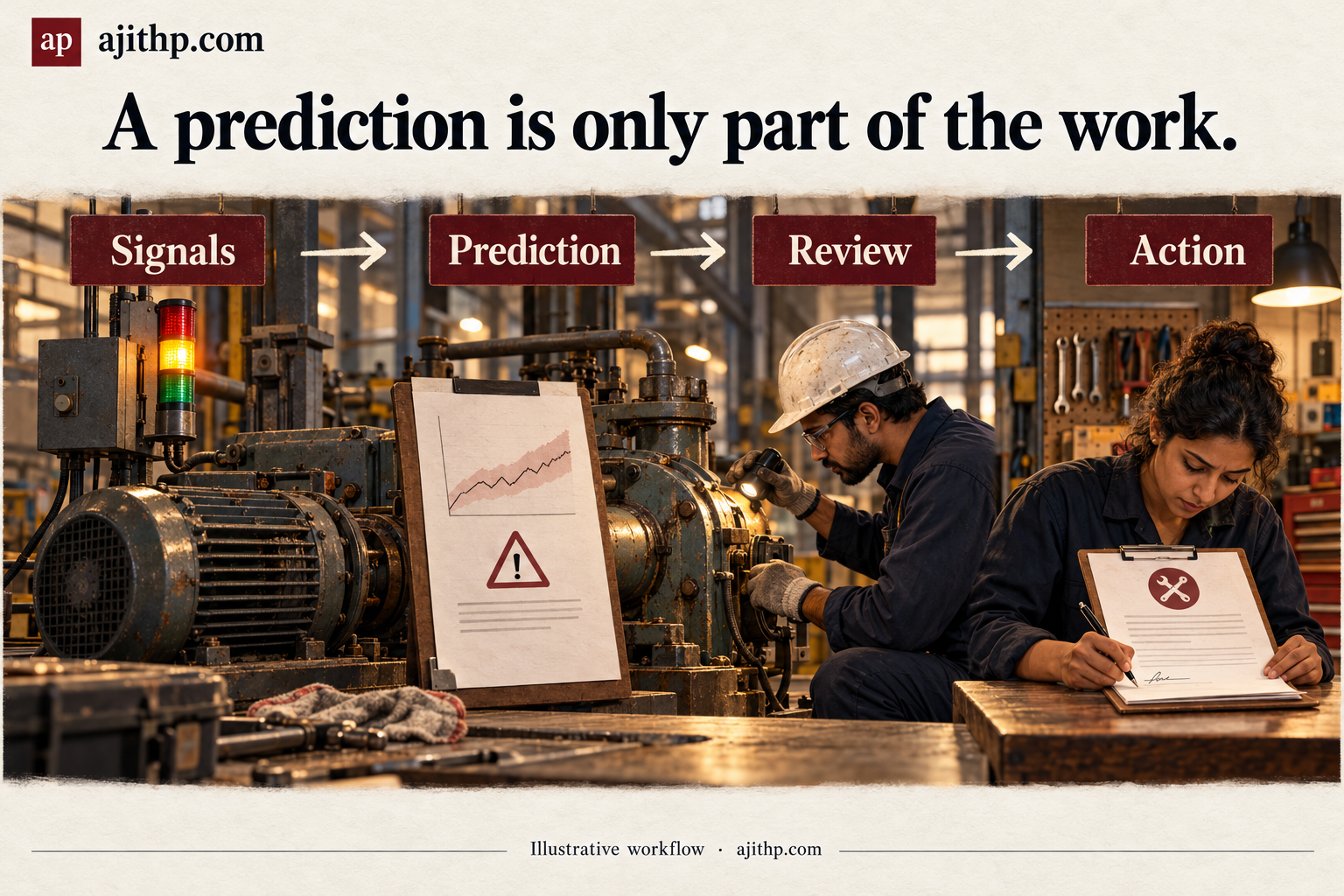
Fault prediction. Sensor readings can be analyzed for patterns that may indicate equipment problems. Such a signal can help maintenance staff investigate and plan work; it cannot guarantee that an outage will be prevented. Performance depends on the equipment, sensor quality, failure data, and maintenance process.
Nuclear energy. A dated example of AI-related work in the nuclear sector is regulatory preparation. The U.S. Nuclear Regulatory Commission’s 2023 Artificial Intelligence Strategic Plan set goals for building staff readiness to review AI applications in NRC-regulated activities. The plan concerns regulatory readiness; it does not describe AI independently controlling a nuclear plant. (NRC, Artificial Intelligence Strategic Plan: Fiscal Years 2023–2027)
A plasma-control research example. Researchers from Google DeepMind and EPFL’s Swiss Plasma Center reported in 2022 that they used deep reinforcement learning to control magnetic coils and shape plasma configurations in the TCV tokamak, a research facility at EPFL’s Swiss Plasma Center. It is a meaningful research demonstration of control methods in experimental fusion science. It is not a fusion power plant, a demonstration of net energy production, or evidence that an AI system generated more power. The distinction matters: controlling plasma shape is one research problem within a much larger effort to produce practical fusion energy. (Degrave et al., Nature, 2022)
Types of Artificial Intelligence

There are several ways to organize the topic. The two taxonomies below are teaching frameworks, not a single official classification used across all AI research. The first groups systems by a proposed kind of functionality; the second describes ideas about the breadth of capability.
Classification based on functionalities
Arend Hintze introduced the four labels—reactive machines, limited memory, theory of mind, and self-aware AI—as a framework for discussing how AI might differ in function. They are useful prompts for discussion, not a standardized checklist for classifying current products. In particular, the last two categories are best treated as hypothetical or philosophical concepts.
1. Reactive Machine
In this teaching category, a system responds to the current input without using memory of prior interactions to shape that response. The classic illustration is a chess program that evaluates the current board and chooses a move. This does not mean the program has no stored rules or learned parameters; it means it does not rely on remembered past games as an ongoing personal experience. Netflix recommendations and spam filters are not clean examples of a “reactive machine,” because their behavior may depend on training data, account signals, or other context.
2. Limited Memory
Some systems use current input together with a limited amount of prior information or state. A driver-assistance system, for example, may combine recent sensor readings with the current scene to estimate movement. That operational context is different from a system remembering every route or learning a new task on its own.
It is useful to distinguish three things that are often blurred together: information used when a model is trained, temporary context used while it is running, and information deliberately stored for future interactions. A virtual assistant or chatbot may use one or more of these, depending on its design. The label “limited memory” does not tell us what a particular service stores or whether it updates its model. Those details have to be checked for the system in question.
3. Theory of Mind
In psychology, theory of mind concerns how people reason about what others know, believe, or intend. Applied to AI, the phrase points to systems that might represent another agent’s perspective and use it when predicting behavior. A navigation assistant that notices a person’s stated destination can recommend a route, but that does not show human-like understanding of the person’s beliefs or intentions. Current language systems can produce text about mental states without demonstrating subjective understanding. The category remains a useful research and philosophy question, not a claim that ordinary AI products possess human social cognition.
4. Self-Aware
Self-aware AI is a speculative and philosophically contested idea. There is no settled engineering test that establishes subjective experience, consciousness, or a human-like sense of self in a machine. A system can describe its limits, monitor its own errors, or refer to itself in text without showing that it experiences anything. Questions about what would count as machine consciousness remain open; current product descriptions should not be read as evidence that such a system exists.
Classification based on capabilities
The labels narrow AI, general AI, and superintelligent AI offer another way to talk about the intended breadth of capability. Their boundaries and definitions vary. The last two are not measured product categories with a shared threshold.
1. Artificial Narrow Intelligence
Narrow AI is a useful label for a system designed or evaluated for a bounded task or set of tasks. A speech-recognition feature, an image-classification model, a route planner, and a voice assistant such as Siri or Alexa are familiar examples. Each product may combine multiple components, and its capabilities depend on its design and version. A task-focused system can sometimes be adapted or connected to new tools, so “cannot adapt” is too absolute. What matters is what the particular system has actually been designed, tested, and authorized to do.
2. Artificial General Intelligence
Artificial general intelligence (AGI) refers to a debated idea of broadly capable AI. There is no single agreed definition or threshold that tells everyone when a system has become AGI. Researchers, companies, and policymakers may use different criteria, so a claim about AGI should be read alongside the definition and evidence being used. This guide treats AGI as a concept under discussion, not a completed stage in a standard development pathway.
3. Artificial Superintelligence
Artificial superintelligence (ASI) is a hypothetical idea of AI that would exceed human abilities across many important domains. Its capabilities, arrival, and consequences are uncertain. AI-safety researchers also study objective misalignment, in which a system optimizes a specified goal or proxy in ways that conflict with the intentions behind it. How such concerns would apply to hypothetical superintelligence remains debated; this label alone cannot predict what a system would do or how society would change. (Amodei et al., “Concrete Problems in AI Safety”)
Types of Machine Learning
Machine learning methods fit models from examples, data, or interaction with an environment. People define objectives, choose or create data, select methods, and evaluate results. The four learning paradigms below help explain how the feedback differs. In practice, methods and system designs can be combined.
1. Supervised Learning
Supervised learning uses examples paired with target labels or values. A model learns a mapping from inputs to those targets so it can estimate the target for new inputs. For instance, a set of reviewed documents labeled “needs follow-up” or “does not need follow-up” could be used to train a classifier. The model’s predictions would still need evaluation against appropriately reviewed examples; they should not be mistaken for the judgment of the subject-matter experts who created the labels.
Decision trees and linear regression are examples of supervised methods, but they solve different kinds of problems. A decision tree can be used for classification or regression, while linear regression estimates a numeric value under a linear model. The choice depends on the task, data, and evaluation needs; none is automatically the best method.
2. Unsupervised Learning
Unsupervised learning fits patterns or structure in data without target labels supplied for each example. The model is still trained or fitted. For example, a clustering method can group customer records according to similarities in selected measurements. Some unsupervised anomaly-detection methods can also flag observations that differ from the patterns in a dataset. These outputs may help someone explore the data, but an unusual record is not automatically meaningful or actionable; people need to examine how the patterns were formed and whether they fit the intended purpose. (scikit-learn, novelty and outlier detection)
3. Semi-Supervised Learning
Semi-supervised learning uses a smaller set of labeled examples together with a larger set of unlabeled data. Under the method’s assumptions, the additional unlabeled examples can help the model learn useful structure. This can be relevant when labels are expensive to obtain, such as when a specialist must review a document or image. It is not simply any combination of supervised and unsupervised models, and it does not guarantee better performance. A text classifier is one possible application; the result still needs testing on examples representative of its intended use.
4. Reinforcement Learning
In reinforcement learning, an agent selects actions in an environment and receives feedback, often expressed as rewards. It uses experience to improve its policy—the way it chooses actions—with an objective such as maximizing expected cumulative reward. A punishment is not a required ingredient; a reward design can simply give more value to some outcomes than others.
Imagine a game-playing agent that receives points for reaching a goal. It may try different actions and learn which sequences tend to earn higher rewards. The result depends on the game, observations, available actions, reward design, and training process. It is not guaranteed to find a truly optimal strategy, and optimizing a poorly chosen reward can produce behavior that misses what people actually wanted. Value iteration and policy iteration are dynamic-programming methods that use a model of the environment. Q-learning is another reinforcement-learning method; it can learn action values from experience without a supplied transition model. These are examples, not steps every system must use. (Watkins and Dayan, “Q-learning”) Research and applications include games, robotics, and control problems, with each use requiring its own evidence and safeguards.
Where AI and ML May Create Future Change

Machine-learning models can identify patterns in data and produce predictions, rankings, or other outputs. Market estimates vary according to what is counted, geography, time horizon, and forecast method. Market size, even when well measured, would not tell us whether any particular system creates value or improves a decision.
AI may influence how leaders and researchers examine problems, but it does not provide insights that people “cannot conceptualize,” nor does it guarantee better decisions. A useful output can widen the set of options someone considers; it can also be incomplete, mistaken, or irrelevant. The people responsible for a decision still need to understand what the system was designed to do and what evidence supports its output.
The IBM survey above captures one pandemic-era account of changes in AI plans. It is a point-in-time result, not a measurement of adoption today.
Organizations can learn more about their operations when they analyze data, but a model’s view is shaped by what an organization records and chooses to measure. When a prediction challenges an established belief, people can use it as a question to investigate—not as proof that the model is correct. Likewise, technology does not automatically adapt to each new disruption; changes to a model and its process require design and evaluation.
AI and ML, sometimes connected with Internet of Things (IoT) devices that collect or transmit measurements, may contribute to new services, business models, research, and changes in work. Their effects on particular jobs and industries depend on how organizations adopt them, what tasks are redesigned, and how the benefits and costs are distributed. It is reasonable to expect change; the scale and direction should not be stated as certainty. As with other technologies, what matters is how people choose to develop and use them.
Sources and further reading
- OECD, Explanatory memorandum on the updated OECD definition of an AI system.
- NIST, AI Risk Management Framework 1.0.
- IBM and Morning Consult, Global AI Adoption Index 2021 executive summary.
- AHRQ, Introduction to Diagnostic Errors, in Cognitive Load Theory and Its Impact on Diagnostic Accuracy. The page summarizes a National Academy of Medicine estimate from 2015.
- U.S. FDA, IDx-DR De Novo classification record and decision summary.
- Digital Diagnostics, IDx-DR product rebrand to LumineticsCore (2023).
- National Cancer Institute, Precision medicine.
- United Nations, World Population Prospects 2022: Summary of Results.
- FAO, Climate-related disasters and food security.
- Degrave et al., Magnetic control of tokamak plasmas through deep reinforcement learning, Nature (2022).
- Hintze, Understand the Four Types of Artificial Intelligence (2016).
- Menze et al., The Multimodal Brain Tumor Image Segmentation Benchmark (BRATS), Scientific Data (2015).
- Amodei et al., Concrete Problems in AI Safety (2016).
- U.S. Nuclear Regulatory Commission, Artificial Intelligence Strategic Plan: Fiscal Years 2023–2027 (2023).
- Watkins and Dayan, Q-learning, Machine Learning (1992).
- scikit-learn developers, Novelty and Outlier Detection.
- National Academy of Sciences, The Frontiers of Machine Learning: 2017 Raymond and Beverly Sackler U.S.-U.K. Scientific Forum (2018).
Discover more from Ajith Vallath Prabhakar
Subscribe to get the latest posts sent to your email.
Clear and synthetic! Thanks!
Awesome 👍 from dailyedutalk.com