

Neuromorphic Computing AI is revolutionizing how artificial intelligence (AI) systems learn and operate by mimicking the human brain’s structure and function. Unlike traditional computing, neuromorphic systems process information more efficiently, enabling real-time learning and energy-saving AI models. In this article, we explore how brain-inspired neuromorphic computing is transforming AI and reshaping industries from healthcare to autonomous vehicles.
Current Advancements in AI and Computing Demands
Artificial intelligence has made remarkable progress in recent years, transforming industries and enabling breakthroughs in fields such as computer vision, natural language processing, and autonomous systems. However, this rapid advancement has also led to a growing demand for high-performance computing resources, particularly GPUs and CPUs, to efficiently process the massive amounts of data and complex algorithms required by cutting-edge AI systems. To understand the need for neuromorphic computing, let’s first examine the current advancements in AI and the limitations of traditional computing systems.
Limitations of Current Computer System Designs
Despite the increasing use of specialized hardware like GPUs and TPUs, current computer systems, based on the von Neumann architecture, still face several limitations when it comes to meeting the computing demands of complex AI systems
- Memory Bottleneck: In traditional architectures, the processor and memory are separate, leading to a bottleneck in data transfer that limits performance. This is especially problematic for AI workloads that require frequent memory access.
- Lack of Parallelism: While modern processors have multiple cores, they still rely on sequential processing, which limits their ability to handle the highly parallel nature of neural networks and other AI algorithms.
- High Energy Consumption: Current computer systems consume significant energy, particularly when running demanding AI workloads. This high power consumption limits the deployment of AI in edge devices and raises concerns about the environmental impact of large-scale AI systems.
- Limited Adaptability: Traditional computer systems are designed to execute predefined instructions and lack the ability to dynamically adapt to new tasks or learn from their environment, which is a key requirement for truly intelligent AI systems.
These limitations make it challenging to meet the growing computing demands of complex AI systems, which require the ability to process vast amounts of data in real-time, adapt to new situations, and operate efficiently at scale. Given these limitations, researchers have turned to neuromorphic computing as a potential solution to meet the growing demands of AI.
Introduction to Neuromorphic Computing
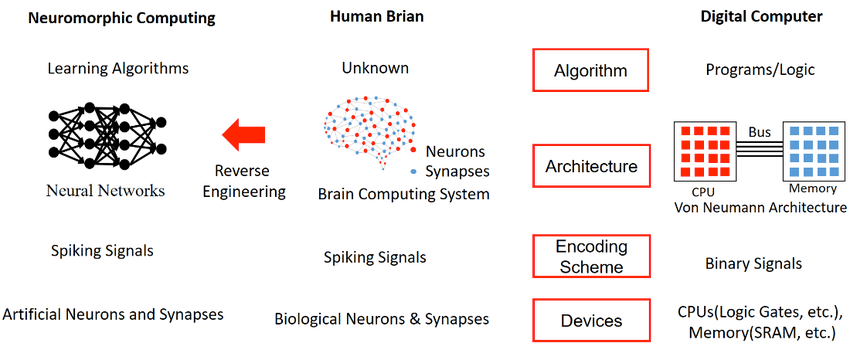
Neuromorphic computing, which draws inspiration from the human brain’s structure and function, offers a promising alternative to traditional computing architectures and seeks to produce artificial neural systems capable of processing information in a manner similar to the brain’s processing of sensory data, decision-making, and behavior control.
Key characteristics of neuromorphic computing include
- Massively Parallel Processing: Neuromorphic systems leverage a large number of simple processing elements that operate in parallel, similar to the neurons in the brain, enabling efficient processing of complex tasks.
- Event-Driven Computation: In neuromorphic systems, computations are triggered by events or spikes, similar to how neurons in the brain communicate, leading to energy-efficient and real-time processing.
- Adaptive Learning: Neuromorphic systems can dynamically adapt and learn from their environment, improving performance over time and handling novel situations without explicit programming.
- Low Power Consumption: By leveraging event-driven processing and low-precision analog computation, neuromorphic systems consume far less power than conventional computers, making them well-suited for edge AI and IoT applications.
By mimicking the brain’s remarkable efficiency and cognitive capabilities, neuromorphic systems have the potential to revolutionize computing and enable powerful new AI applications.
Historical Context of Neuromorphic Computing
It’s essential to understand the history of neuromorphic computing in order to appreciate its evolution. Neuromorphic computing originated in the 1980s when scientists and researchers started to explore the concept of creating artificial neural networks based on the structure and function of the human brain. The term “neuromorphic” was coined by Carver Mead, a professor at the California Institute of Technology, in his 1990 paper “Neuromorphic Electronic Systems.”
Key milestones in the history of neuromorphic computing include:
- 1960s: Frank Rosenblatt introduces the concept of the perceptron, a simple artificial neuron that laid the foundation for later work on artificial neural networks.
- 1980s: Researchers, including Carver Mead, began exploring the idea of creating electronic circuits that mimic the behavior of biological neurons.
- 1990: Carver Mead publishes his seminal paper “Neuromorphic Electronic Systems,” which outlines the principles of neuromorphic computing and its potential applications.
- 1990s: The first neuromorphic chips, such as the Silicon Retina and the Silicon Cochlea, are developed, demonstrating the feasibility of implementing neural-inspired circuits in hardware.
- 2000s: Neuromorphic computing gains momentum with the development of more advanced neuromorphic chips and the emergence of large-scale research projects, such as the Blue Brain Project and the SyNAPSE (Systems of Neuromorphic Adaptive Plastic Scalable Electronics) initiative.
- 2010s: Major tech companies, including IBM, Intel, and Qualcomm, begin investing in neuromorphic computing research and development, recognizing its potential to revolutionize computing and AI.
- 2020s: Neuromorphic computing continues to advance, with the development of increasingly sophisticated neuromorphic chips, such as Intel’s Loihi and IBM’s TrueNorth, and the exploration of new applications in areas like robotics, autonomous systems, and edge computing.
Throughout its history, neuromorphic computing has been driven by the desire to create more efficient, adaptable, and intelligent computing systems that can handle the complex challenges of the modern world. As the field continues to evolve, it promises to enable transformative breakthroughs in AI and beyond, reshaping the future of technology and our understanding of computing itself.
Fundamental Components: Neurons, Synapses, and Neural Networks

To mimic the brain’s structure and function, neuromorphic systems rely on three key components:
Artificial Neurons
Neuromorphic systems rely on artificial neurons as their fundamental processing units, which are akin to biological neurons found in the brain. A biological neuron comprises a cell body, dendrites, and an axon. Dendrites receive signals from other neurons, the cell body processes these signals, and the axon transmits the processed signals to other neurons.
Similarly, artificial neurons receive input signals, process them, and produce output signals. These artificial neurons are constructed using electronic circuits that imitate the behavior of biological neurons. They can handle various inputs, process information based on specific rules, and generate outputs that affect other neurons in the network.
Imagine artificial neurons as tiny processors that can handle multiple tasks simultaneously, similar to how our brain simultaneously processes different senses like sight, sound, and touch.
Artificial Synapses

Synapses are the connections between neurons that enable communication and learning. In the human brain, synapses are small gaps where neurotransmitters are released to pass signals from one neuron to another. These connections can be strengthened or weakened based on how frequently they are used—a process known as synaptic plasticity. This ability to change strength is crucial for learning and memory.
In neuromorphic systems, artificial synapses function in a similar way. They connect artificial neurons and can adjust the strength of these connections based on learning algorithms. This means that over time, the system can learn and adapt by changing the synaptic weights, much like the brain does.
Think of artificial synapses as adjustable bridges between neurons. The more often a bridge is used, the stronger and more efficient it becomes, allowing for better communication and learning within the network.
Artificial Neural Networks
Neuromorphic systems organize artificial neurons and synapses into networks that resemble the structure of biological neural networks. By connecting many neurons through synapses, neuromorphic systems form neural networks. These networks can perform complex computations and solve problems in a way that mimics the brain’s functionality. Neural networks are organized in layers, with each layer transforming the input data into more refined representations.
In neuromorphic computing, neural networks are used to recognize patterns, make decisions, and perform tasks that traditional computers struggle with. For instance, they can be used in image recognition, natural language processing, and real-time decision-making applications.
Picture a neural network as a team of specialists working together. Each specialist (neuron) has a specific task, and they communicate through connections (synapses) to solve a complex problem efficiently.
With an understanding of neurons, synapses, and neural networks, we can now explore how these components work together in neuromorphic computing systems.
How Neuromorphic Computing Works

Neuromorphic computing systems leverage the properties of artificial neurons, synapses, and neural networks to process information in a brain-like manner. It uses a fundamentally different approach to traditional computing. It’s important to understand the architecture, design principles, and key differences between neuromorphic and conventional computing to fully grasp the potential and implications of this emerging field.
Architecture and Design Principles
Neuromorphic systems are built upon a set of core architectural and design principles that enable them to process information in a brain-like manner. Here’s a breakdown of its key design principles:
Spiking Neural Networks (SNNs)
Neuromorphic systems use Spiking Neural Networks, where neurons communicate through discrete spikes or pulses of electrical activity. Unlike traditional artificial neural networks that use continuous values, SNNs are more energy-efficient and can process information in a way that is closer to how biological neurons work. These spikes are events that occur at specific points in time, making communication more dynamic and responsive.
Imagine each neuron as a small light bulb that flashes briefly to send a signal. The timing and pattern of these flashes carry important information, similar to Morse code.
Distributed Processing
Neuromorphic systems consist of a large number of simple processing elements (artificial neurons) that operate in parallel and are distributed across the network. This distributed processing allows for efficient computation and fault tolerance, as the system can continue to function even if some elements fail.
Event-Driven Computation
In neuromorphic systems, computations are triggered by events or spikes, similar to how neurons in the brain communicate. This is different from traditional systems that continuously process data regardless of changes in the input. The event-driven model enables energy-efficient processing, as computations are performed only when necessary, and allows for real-time response to input stimuli.
Asynchronous Communication
Neuromorphic systems employ asynchronous communication protocols, where neurons can send and receive signals independently without relying on a global clock. This asynchronous communication allows for more efficient and flexible information processing, as different parts of the network can operate at their own pace.
Local Learning and Memory
Neuromorphic systems, like the human brain, have the ability to learn and adapt over time. This is made possible through local synaptic plasticity mechanisms, such as spike-timing-dependent plasticity (STDP), which causes the strength of connections between neurons to change based on experience. Learning algorithms adjust the synaptic weights in order to enhance performance on specific tasks.
Scalability and Modularity
Neuromorphic architectures are designed to be scalable and modular, which allows for the creation of large-scale networks capable of handling complex tasks. This scalability is achieved through the use of hierarchical and recurrent connections, as well as the ability to combine multiple neuromorphic modules to form larger systems.
Comparison with Traditional Computing
Neuromorphic computing differs significantly from traditional computing in several ways. Here is a table summarizing the key differences between traditional computing and neuromorphic computing:
| Aspect | Neuromorphic Computing | Traditional Computing |
|---|---|---|
| Processing Model | – Distributed and parallel processing- Memory and processing integrated | – Von Neumann architecture (separate memory and processing units)- Sequential processing |
| Data Representation | – Spiking or rate-based representations- Analog and event-driven | – Binary representations and precise numeric values- Digital and clock-driven |
| Energy Efficiency | – High energy efficiency due to event-driven processing and analog circuits – Well-suited for edge computing and IoT applications | – Higher power consumption due to continuous processing and digital circuits – Power consumption can be a limitation for edge devices |
| Adaptability and Learning | – Ability to learn and adapt based on experiences – Local learning rules and synaptic plasticity | – Requires explicit reprogramming to adapt to new tasks – Limited adaptability and learning capabilities |
| Fault Tolerance | – Inherently fault-tolerant due to distributed nature – Failure of individual elements does not necessarily compromise overall functionality | – Single component failure can lead to complete system breakdown – Limited fault tolerance |
| Scalability | – Designed to be scalable and modular – Hierarchical and recurrent connections enable large-scale networks | – Scalability can be limited by the von Neumann bottleneck and centralized control – Scaling up requires complex synchronization and communication mechanisms |
| Application Domains | – Well-suited for tasks that require real-time processing, adaptability, and energy efficiency – Promising for edge computing, IoT, robotics, and autonomous systems | – Dominates in tasks that require high-precision arithmetic and symbolic manipulation- Well -established in general-purpose computing, data storage, and communication |
Importance and Relevance of Neuromorphic Computing in Today’s Tech Landscape
Neuromorphic computing has gained significant attention in recent years due to its potential to address the limitations of current computer systems and meet the increasing demand for more efficient, adaptable, and intelligent computing systems.
As traditional computing approaches struggle to keep pace with the explosive growth of data and the complexity of modern AI workloads, neuromorphic architectures offer several key advantages:
- Energy Efficiency: Neuromorphic systems consume far less power than conventional computers, making them well-suited for edge AI and IoT applications where power consumption is critical.
- Real-Time Processing: Neuromorphic chips’ brain-inspired parallel processing enables real-time processing of sensory data, which is critical for applications like autonomous vehicles, robotics, and augmented reality.
- Adaptability: Neuromorphic systems can dynamically adapt and learn from their environment, allowing them to handle novel situations and improve performance over time without explicit programming.
- Scalability: The distributed, modular nature of neuromorphic architectures allows for easy scalability to handle larger and more complex tasks as needed.
As the demand for intelligent, efficient, and adaptive computing continues to grow across industries, neuromorphic computing is poised to play an increasingly important role in shaping the future of technology. By addressing the limitations of current computer systems and enabling new possibilities for AI and beyond, neuromorphic computing has the potential to drive transformative breakthroughs in a wide range of domains, from edge devices to data centers and from autonomous systems to personalized healthcare.
Applications of Neuromorphic Computing
Neuromorphic computing has the potential to revolutionize a wide range of applications. This is due to its energy efficiency, real-time processing capabilities, and ability to adapt and learn. As the technology continues to advance, neuromorphic systems are expected to have a significant impact on various industries. They will enable new possibilities and transform the way we process and interact with data.
Real-World Examples and Use Cases
- Edge Computing and Internet of Things (IoT): Neuromorphic systems are well-suited for edge computing and IoT applications, where low power consumption and real-time processing are critical. For example, neuromorphic chips can be used in smart sensors, wearable devices, and autonomous systems to efficiently process sensor data and make decisions without relying on cloud connectivity.
- Robotics and Autonomous Systems: Neuromorphic computing can enable more intelligent and adaptable robots and autonomous systems. By leveraging the real-time processing and learning capabilities of neuromorphic systems, robots can better navigate complex environments, interact with humans, and adapt to new situations without explicit reprogramming.
- Computer Vision and Image Processing: Neuromorphic systems can efficiently process and analyze visual data, making them suitable for applications like object recognition, facial recognition, and motion detection. The event-driven nature of neuromorphic computing allows for fast and low-power processing of visual information, enabling real-time computer vision applications.
- Natural Language Processing (NLP) and Speech Recognition: Neuromorphic computing can be applied to NLP and speech recognition tasks, enabling more efficient and accurate processing of language data. The ability of neuromorphic systems to learn and adapt can lead to improved performance in tasks like sentiment analysis, machine translation, and voice-based interfaces.
- Biomedical and Healthcare Applications: Neuromorphic systems can be used in various biomedical and healthcare applications, such as neural prosthetics, brain-machine interfaces, and personalized medicine. For example, neuromorphic chips can be used to process and analyze biomedical signals in real time, enabling closed-loop therapies and assistive technologies.
Potential Impact on Various Industries
Automotive Industry
Through the adoption of neuromorphic computing, the automotive industry can develop more efficient and intelligent vehicle systems. Neuromorphic systems have the capability to process sensor data, make real-time decisions, and adapt to changing road conditions, thereby enhancing safety and performance in a wide range of applications from advanced driver assistance systems (ADAS) to fully autonomous vehicles.
Manufacturing and Industrial Automation
Neuromorphic systems can be used in manufacturing and industrial automation to optimize processes, improve quality control, and reduce downtime. By leveraging the real-time processing and adaptability of neuromorphic computing, industrial systems can become more efficient, flexible, and responsive to changing demands.
Healthcare and Medical Devices
The application of neuromorphic computing in healthcare and medical devices can lead to improved patient outcomes and personalized treatments. Neuromorphic systems can be used to analyze medical data, assist in diagnosis, and control medical devices, such as neural prosthetics and closed-loop drug delivery systems.
Telecommunications and Networking
Neuromorphic computing can be applied to optimize and secure telecommunications and networking infrastructure. Byusing neuromorphic systems for tasks like network traffic analysis, anomaly detection, and resource allocation, telecommunications providers can improve network performance, reduce latency, and enhance security.
Finance and Fraud Detection
Neuromorphic systems can be used in the finance industry for tasks like fraud detection, risk assessment, and algorithmic trading. The ability of neuromorphic computing to process large amounts of data in real-time and adapt to new patterns can help financial institutions detect and prevent fraudulent activities more effectively.
As neuromorphic computing continues to advance and become more sophisticated, its applications and influence across various industries are anticipated to expand. The distinctive features of neuromorphic systems, including energy efficiency, real-time processing, and adaptability, position them well to address significant challenges in fields such asedge computing, robotics, healthcare, and finance.
Advancements in Neuromorphic Chips
The field of neuromorphic computing has witnessed significant progress in recent years, with major tech companies and research institutions developing advanced neuromorphic chips that push the boundaries of this technology. These advancements have led to more powerful, efficient, and adaptable neuromorphic systems, paving the way for new applications and innovations.
Intel’s Loihi Chip
- Architecture and Capabilities: Intel’s Loihi chip is a prime example of advanced neuromorphic computing. It contains over 2 billion transistors and 130,000 artificial neurons, capable of simulating complex neural networks with high efficiency. The Loihi chip uses asynchronous spiking neural networks, which allows it to process information in a way that mimics the brain’s natural processes.
- Applications and Use Cases: Loihi has been used in various research projects, including robotic navigation, olfactory recognition, and adaptive control systems. Its ability to learn and adapt in real time makes it ideal for these applications.
- Example: Researchers have used the Loihi chip to create a robotic arm that can learn to grasp objects through trial and error, demonstrating the chip’s ability to handle complex tasks with minimal pre-programming.
IBM’s TrueNorth Chip
- Architecture and Capabilities: IBM’s TrueNorth chip is another significant development in neuromorphic computing. It features 1 million programmable neurons and 256 million synapses. TrueNorth’s architecture is highly parallel, enabling it to perform a wide range of tasks efficiently.
- Applications and Use Cases: TrueNorth has been applied in image and pattern recognition, data compression, and real-time signal processing. Its low power consumption makes it suitable for mobile and embedded applications.
- Example: TrueNorth has been utilized in visual recognition systems to process and identify images in real time, demonstrating its potential in enhancing AI-driven surveillance systems.
Qualcomm’s Zeroth Platform
- Architecture and Capabilities: Qualcomm’s Zeroth platform aims to bring neuromorphic computing to mobile devices. It integrates neuromorphic principles with traditional digital processing to achieve high efficiency and adaptability.
- Applications and Use Cases: The Zeroth platform is designed for applications in mobile AI, such as speech recognition, contextual awareness, and user behavior prediction. Its integration with mobile chipsets allows for on-device AI processing, reducing the need for cloud-based computation.
- Example: In a smartphone, the Zeroth platform can enable more intuitive voice assistants that adapt to user’s preferences and habits, providing a more personalized experience.
Research and Collaboration
Ongoing research and collaboration between industry and academia are driving continuous improvements in neuromorphic technology:
- Collaborative Research Initiatives: The Human Brain Project, a large-scale research initiative funded by the European Union, aims to advance our understanding of the human brain and develop neuromorphic computing technologies. By fostering collaboration between neuroscientists and computer scientists, the project is pushing the boundaries of what neuromorphic systems can achieve.
- Development of New Materials: Researchers are exploring the use of memristors and other novel materials to create more efficient and accurate artificial synapses. These materials can better mimic the behavior of biological synapses, leading to improved performance and energy efficiency in neuromorphic chips.
- Enhanced Learning Algorithms: Advances in machine learning algorithms are being integrated into neuromorphic systems to enhance their learning capabilities. Techniques like reinforcement learning and unsupervised learning are being adapted to work with spiking neural networks, enabling more sophisticated and autonomous systems.
As neuromorphic chips continue to advance, they are expected to play an increasingly important role in various applications, from edge computing and robotics to scientific simulations and personalized medicine. The ongoing research and development efforts in this field are driving innovation and pushing the boundaries of what is possible with neuromorphic computing. Despite these impressive advancements, neuromorphic computing still faces several challenges that need to be addressed to realize its full potential.
Challenges and Future Directions
Neuromorphic chips such as Intel’s Loihi and IBM’s TrueNorth demonstrate the potential of this technology. However, researchers need to address several limitations and obstacles to facilitate widespread adoption. Nevertheless, ongoing research and future prospects present exciting opportunities for the further advancement and widespread adoption of neuromorphic technologies.
Neuromorphic computing has made significant progress and shows great potential. However, the field still faces challenges and limitations that need to be addressed to realize its transformative potential fully. Ongoing research and future prospects offer exciting opportunities for further advancement and widespread adoption of neuromorphic technologies.
Current Limitations and Obstacles
- Hardware Complexity: Designing and fabricating neuromorphic hardware is a complex and resource-intensive process. The current limitations in materials, manufacturing techniques, and device architectures pose challenges in creating large-scale, reliable, and cost-effective neuromorphic systems.
- Software and Algorithm Development: Developing software and algorithms that can effectively utilize the unique capabilities of neuromorphic hardware is a significant challenge. The event-driven, asynchronous nature of neuromorphic computing necessitates new programming paradigms and tools, as well as the adaptation of existing algorithms to fit the neuromorphic framework.
- Lack of Standardization: The field of neuromorphic computing currently lacks standardization in terms of hardware interfaces, software frameworks, and benchmarking methodologies. This lack of standardization hinders interoperability, reproducibility, and collaboration among researchers and developers.
- Limited Understanding of Biological Neural Networks: Our understanding of biological neural networks is still limited, which affects the performance and adaptability of current neuromorphic systems. These systems may not fully capture the complexity and efficiency of the human brain, as our knowledge of the brain is incomplete.
- Scalability and Integration: Scaling up neuromorphic systems to handle larger and more complex tasks remains a challenge. Integrating neuromorphic components with existing computing infrastructure and ensuring seamless communication and data exchange between neuromorphic and conventional systems is another hurdle to overcome.
Future Prospects and Ongoing Research
- Advanced Materials and Devices: Researchers are actively exploring new materials and device architectures to enhance the performance, efficiency, and scalability of neuromorphic hardware. Advances in memristive devices, spintronics, and photonics offer promising avenues for creating more powerful and compact neuromorphic systems.
- Hybrid Neuromorphic-Conventional Computing: The development of hybrid systems that combine neuromorphic and conventional computing elements is currently an active area of research. These hybridapproaches aim to harness the strengths of both paradigms, enabling the creation of more flexible and efficient computing systems capable of handling a wide range of tasks.
- Neuromorphic-Inspired Algorithms and Software: Researchers are developing new algorithms and software frameworks for efficient mapping onto neuromorphic hardware. This involves creating event-driven programming models, spiking neural network algorithms, and machine learning techniques tailored for neuromorphic systems.
- Neuromorphic Computing for Edge AI: Neuromorphic systems are ideal for edge AI applications due to their low power consumption and real-time processing capabilities. Current research is dedicated to creating neuromorphic solutions for edge devices, which will allow for the development of independent and responsive systems that can operate without relying on cloud connectivity.
- Neuromorphic Computing for Scientific Discovery: Neuromorphic systems have the potential to speed up scientific discovery by enabling the simulation and analysis of complex systems. This includes biological neural networks, physical phenomena, and chemical reactions. Researchers are investigating the use of neuromorphic computing in fields such as neuroscience, physics, and chemistry to gain new insights and drive innovation.
The field of neuromorphic computing is continuously advancing. It’s crucial to tackle challenges and pursue new research directions to unleash its full potential. The future of neuromorphic computing appears promising, with the potential to revolutionize various industries and pave the way for new frontiers in artificial intelligence, scientific discovery, and technological advancement.
Related Articles


Conclusion
Neuromorphic computing is a groundbreaking shift in computer system design and functionality inspired by the efficiency and adaptability of the human brain. It addresses the limitations of traditional von Neumann architectures and offers significant advantages in parallel processing, energy efficiency, adaptability, and real-time processing.
Advanced neuromorphic chips like Intel’s Loihi, IBM’s TrueNorth, and Qualcomm’s Zeroth platform showcase the potential of this technology to revolutionize various fields. From enhancing robotic navigation and medical diagnostics to optimizing financial transactions and enabling smarter IoT devices, neuromorphic computing is poised to drive significant advancements across multiple industries.
Ongoing research and collaboration between academia and industry are crucial for overcoming current challenges and pushing the boundaries of what neuromorphic computing can achieve. As this field continues to evolve, we can expect neuromorphic systems to play an increasingly important role in developing more intelligent, efficient, and adaptable computing solutions.
In summary, neuromorphic computing holds the promise of transforming our technological landscape by providing innovative solutions that mimic the brain’s natural processes. This has the potential to unlock new possibilities for artificial intelligence, drive scientific discovery, and create a more sustainable and intelligent future.
Discover more from Ajith Vallath Prabhakar
Subscribe to get the latest posts sent to your email.

You must be logged in to post a comment.